







About the Game

Interactive and immersive learning
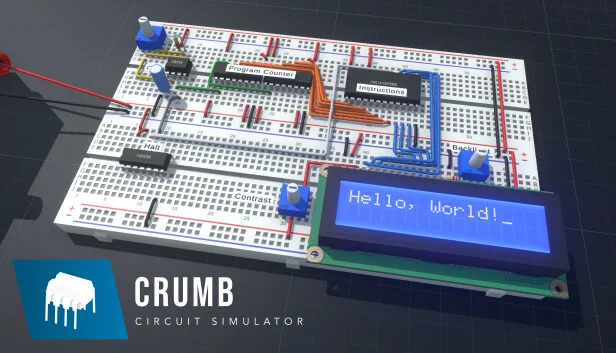
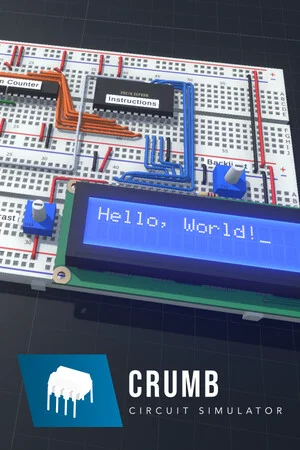
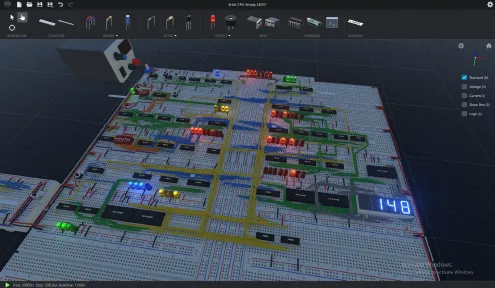
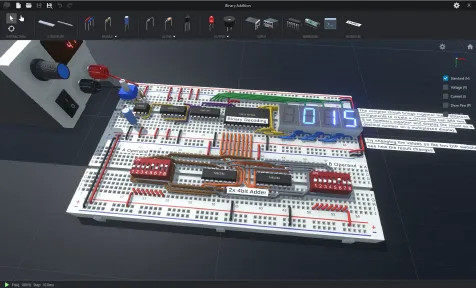
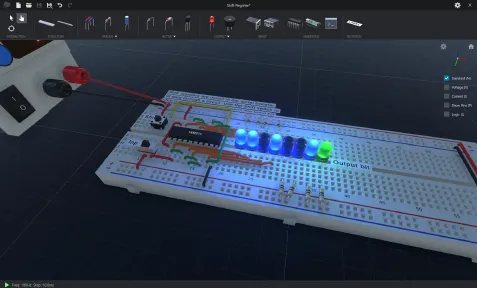
CRUMB offers an easy to use and interactive introduction to electronic circuitry. Fully realised in 3D, you can construct prototype circuits as you would at the workbench without the risk of terminal component failure or the hassle of ordering individual components. A broad selection of parts and features offers an insight into many different areas of modern electronics
Large catalogue of components
CRUMB has a varied selection of components, even at this early stage in its development. There are no limits to what circuits you can create. CRUMB includes several built-in examples which showcase some of the abilities of CRUMB. This list below highlights some of the included components- Passives such as Resistors, Capacitors and Inductors
- Tactile, slide and DIP switches
- Semiconductors such as Diodes, BJT Transistors, MOSFETs and Silicon Controlled Rectifiers
- LEDS, Transducers, Seven Segment displays
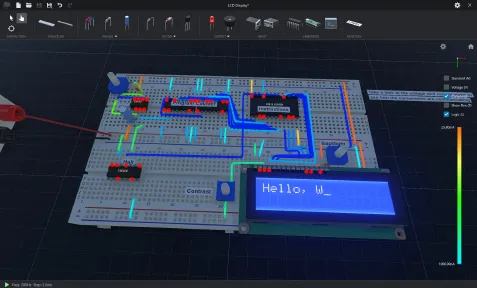
- LCD and TFT displays
- DC Power and Signal Generators
- Large selection of Integrated Circuits ranging from Basic to Complex Logic, Timers, Counters, Memory, EEPROM and Op Amps
- Fully programmable Microcontroller
Advanced features
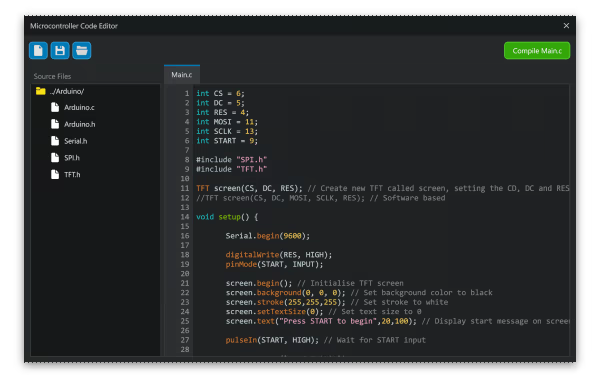
The latest update has expanded some of the special features included with CRUMBCode Editor
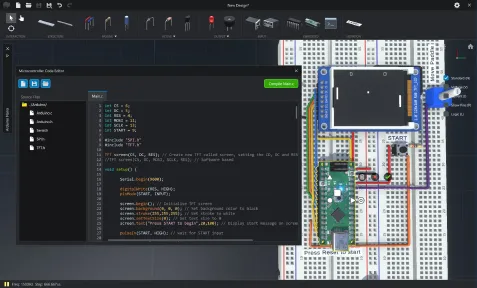
The built-in Code Editor has been expanded to allow the viewing and editing of the Source Files that I have written for the programmable Microcontroller included in CRUMB
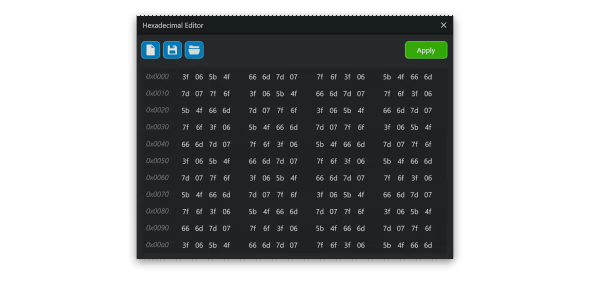
Hex Editor
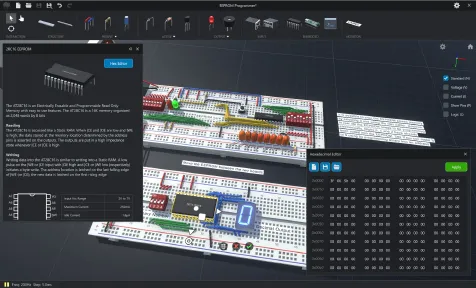
This is an EEPROM available to use which can be programmed via circuitry (see built-in example) or values can be entered manually with the built-in hex editor
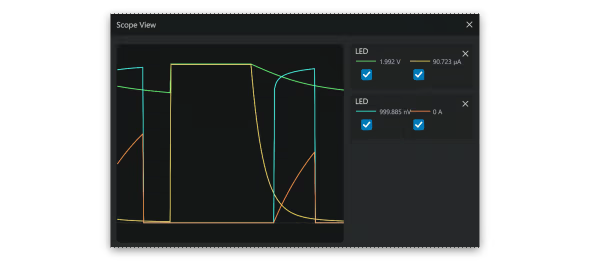
Scope Analysis
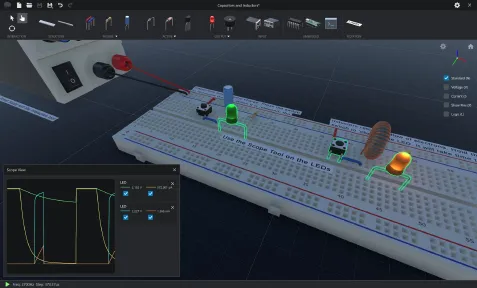
Up to 4 components can be added to the built-in scope, allowing you to view the intricacies of your circuit
Visualisation
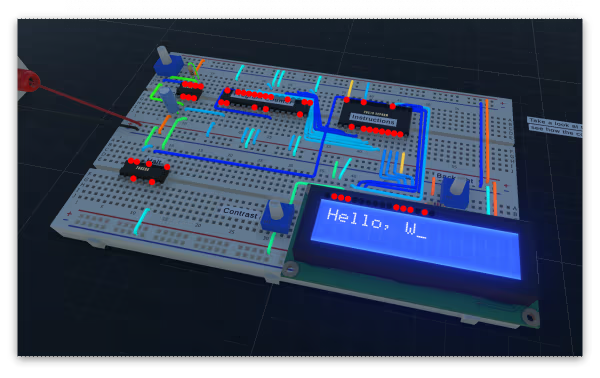
CRUMB offers a set of different visualisations tools. You can view current and voltages in the wires, logic output at the pins of various components, highlight the pin labels and anodes of polarized components and switch off the scene lighting for dark mode
Screenshots
8 images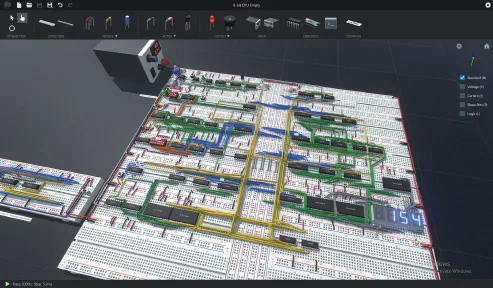
Version Information
Steam Patch Notes
Official update history
[img src="{STEAM_CLAN_IMAGE}/43155574/f06450d24ea5df8e0d45bebfc12714c502adb324.png"]
Just a quick little preview screenshot from the development build 🤩 I will post a major update soon regarding release for 2.0.
But honestly, just look at that.... A proper Scope, showing trigger edges. A Multimeter with true to life options 😁 I listened to all of the feedback and settled on one thing, the next version of CRUMB is to be a world leader in electronic interactivity that is true to life!
Lastly, a warm welcome to all the new users from the recent sale! You are very lucky to have come onboard for the journey and will have full access to this next edition on release!
Speak to you all soon!
Mike
CRUMB 2.0 update:
Still hard at work, but I think I am at the point of needing to move from a solo project and make a team. I am putting in alot of hours!
- 74HC245 fixed issue with the DIR pin not functioning correctly and causing a crash due to matrix error
- Corrected pin labels for 74HC245 and 74HC273
- Fix issue with a single remaining pin label after a component delete with pin hints enabled
All the best
Mike
The performance loss is negligible, if any, and should stop crashing for affected users!
As always, please get in touch with any issues that you may be having
All the best
Mike
I have updated a few key areas, which should significantly improve stability and hopefully stop some users getting crashes when placing unconnected components and creating wire loops with switches. Circuit Math is very complex and I am always improving the detection of singular matrices or convergence issues
I had managed to miss out a critical multiplication when optimising the Transistor, which was causing convergence issues for the simulation!
All the best
Mike
I am for the most part complete with the speed update, it is actually now possible to run some of the circuits at 96,000Hz which is great news... especially if you want to create circuits for audio/analog processing 😍
However, I am going through a few checks and tidy ups with everything to do with audio input as I want to compile two updates in to one, as I feel like everyone has waited for long enough for an update!
I am still aiming to be finished within the next week or two, please just bear with me 😊
Long time since the last update, but I have still been working away hard between my real job and young family! I have been gathering lots of info from all the users and my whiteboard is now covered in ideas and feature requests
I am not quite ready to show new screenshots/video recordings as the latest User Interface is very much in a debug/alpha phase and does not represent what the final version will be like. However below is a summary of the new features that will be coming in the future
- User created components - Parts can be created from scratch and programmed to suit requirements, this means that the catalogue of components will expand over time with community input. You will have the ability to upload your own 3d models, specify wiring locations, variables and complex electrical interactions
- Electromechanical - The next version will give the ability to build and construct electromechanical systems, such as robots. Complete with Physics simulation
- Steam Workshop - Highly requested, Steam Workshop will allow the community to really come together with learning and the creation of new components and sharing of designs
- Revamped User Interface - The usage and feel of CRUMB will be closer to that of a dedicated 3D CAD program to help bring CRUMB closer to be a professional too
There are more features to list, but I will share them in due course... just want to get a quick update out so that everyone knows that CRUMB is not dead!!
Mike
CRUMB Forum post
Basically as a temporary measure, if you would like to use the current version of CRUMB before I get the big update, you need to change your system Locale to English(UK) and it will correct the internal issues with number exchanging between the simulation process and the UI
A guide how to do this can be found here https://www.isunshare.com/windows-10/change-system-locale-in-windows-10.html
Again, my deepest apologies for this issue and I am working as fast I can to get the updated version out as soon as I can!
All the best
Mike
It should take me around about 2 weeks to complete, but it will also mean that CRUMB will also be supported on Mac and Linux
Bear with me! I shall keep everyone updated
Mike
Hello everyone! Mike here... the solo developer behind this project!
Thank you to every one who has downloaded CRUMB, and I appreciate your patience with a few issues that have become apparent. I have quickly put together a quick patch to fix some major and minor issues. Please see below
Major Fixes
- Numerical entry fields on components now accept the comma and the dot as a decimal separator
- Resolved crashing when unexpected values are entered into the numerical entry fields
Unknown Resolution
- Issue with CRUMB crashing when selecting the gear icon to adjust the simulator speeds. I have adjusted some code that I think is the issue. However I have not been able to reproduce the issue on my 3 laptops. Please let me know if the issue is fixed or not
Minor fixes
- Jumper wire is now correct colour according to selection when starting a new wire
- Collider sizes adjusted for some of the interactable components. There were some overlapping issues when components were placed together
Investigated Issues
- Waveform type knob not working on the signal generator. I have checked this and the knob works correctly. To avoid confusion, it works in exactly the same way as the voltage and frequency knobs by dragging with the interaction tool
- Steam Overlay is causing issues with the multiple UI items on the app startup. CRUMB does not use any of the Steam Overlay features, so feel free to disable the Overlay by right clicking on CRUMB in your library and navigating to General Properties. I will ask Steam to update my app to disable overlay
Future fixes and updates
- DPI scaling. Several users with 4k screens are finding it difficult to use the UI as it doesn't adjust
- I will update placement of components, allowing rotating of some of the components that snap to the rotation of the breadboard
- I will add in keyboard shortcuts
- I will add in tutorials and guides to better understand components
- Plus much much more...
Again, I thank you for your patience and support! I will work on the next set of updates as soon as I can
All the best
Mike
Current Release
Not available
System Requirements
How to Install
CRUMB.exe to play
Troubleshooting tips
• Run Redist/_CommonRedist installers if game won't start
• Add folder to Windows Defender exclusions
• Run as administrator
Download
Direct link available
Needed when extracting (WinRAR / 7-Zip) — not a site login.
977E9CDF
22e0645a0d684ad09425057aa4d63e59f58b7636dbeba60dbcc3a6abd8d8610d
You May Also Like
View All







Download CRUMB Circuit Simulator for PC with a direct link or via torrent. Get the full version of CRUMB Circuit Simulator for free. CRUMB Circuit Simulator is a Simulation released by Mike Bushell.