






About the Game
Stack the plates. Pick the round. See what actually happens.
ArmorSim is a 3D terminal ballistics simulator built for people who argue about armour for fun. One question drives the whole thing: will it go through?
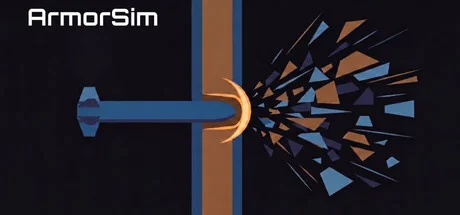
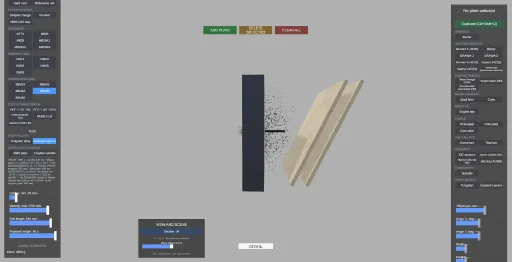
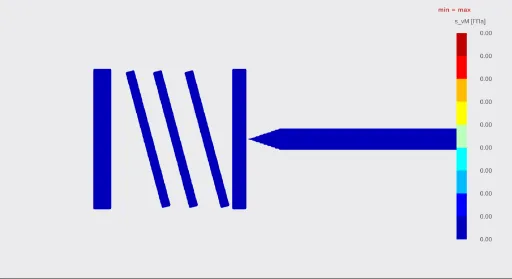
You build the target — plates, thicknesses, angles, spacing, materials. You build the projectile, or take a real one from the American, Soviet/Russian and German arsenals. Then you fire, and the impact is solved, not animated. The rod grinds itself down. The plate dishes, tears, punches out a plug or opens a ragged hole. Fragments fly with real mass behind them. You orbit the camera around the whole thing in slow motion and look at the damage from any angle you like.
No sparks. No glow. No explosion smoke. Just metal doing what metal does.
Three solvers, one sandbox
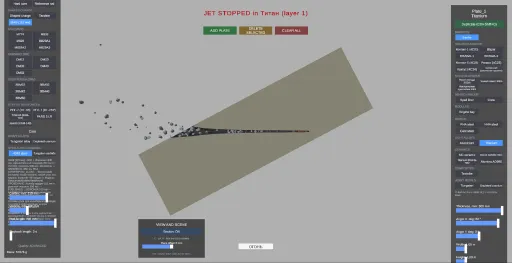
NORMAL — the fast one. Analytic terminal ballistics: Alekseevskii–Tate erosion integration, Recht–Ipson residual velocity, a Rosenberg ricochet criterion, Grady fragmentation. Answer in a fraction of a second. Fire, tweak one number, fire again.
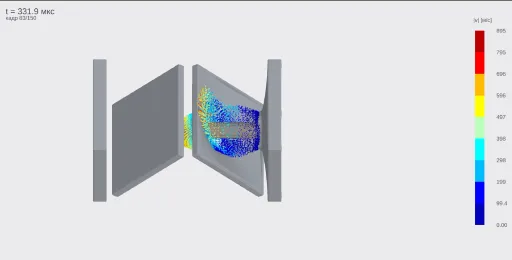
ADVANCED — the same core with its guts on the table. Layered and spaced arrays, reactive armour packs, per-layer energy accounting. Ballistic limit, wear fraction and residual velocity reported for every plate the rod passes through, so you can see exactly where the shot ran out of energy.
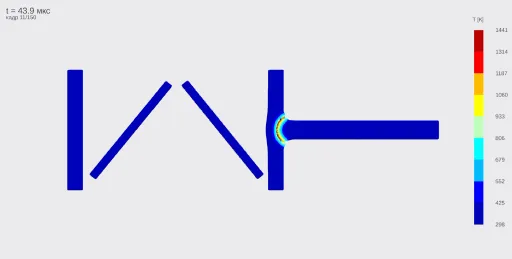
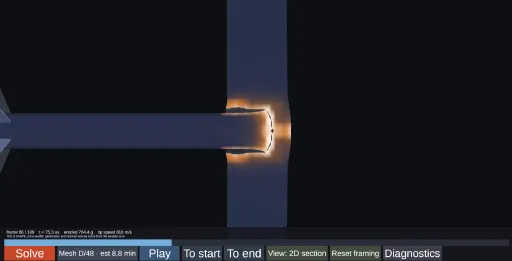
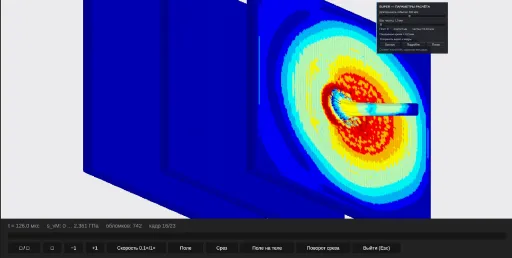
ULTRA — a genuine continuum solver. An axisymmetric Lagrangian mesh running Johnson–Cook plasticity, a Mie-Grüneisen equation of state, adiabatic shear banding and element erosion. It takes minutes to produce a single impact. The crater shape is not drawn by an artist — it falls out of the physics.
Physics, not hardness points
There is not a single hit point anywhere in ArmorSim. Every outcome comes out of published models driven by real material properties — density, yield strength, shock data from laboratory tests. Rod erosion, ragged hole edges, plug ejection and fragment formation are consequences of those numbers, not animations played back on cue.
It is not a hydrocode, and it does not pretend to be one. An ANSYS-class simulation of this impact runs for hours on a cluster. Here is what ArmorSim does instead of pretending:
Every material constant carries a source. The material table tags each number MEASURED, DERIVED, FITTED or ASSUMED, and names the paper it came from. It is not hidden — you can open it and check.
Absences are documented, not filled in. Where the open literature holds no usable data, the material is not quietly faked with a stand-in. It is marked unsupported, and the reason is spelled out.
ULTRA states its own limits. The continuum mode is axisymmetric. It runs head-on impacts, and it tells you plainly when a scene falls outside what it can honestly solve instead of guessing at it.
The solvers never contradict each other. ULTRA renders the shape of the damage; the analytic core is the only thing permitted to declare an outcome. You will never get two different answers to the same shot.
What you get
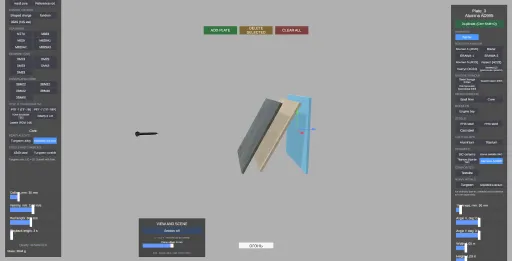
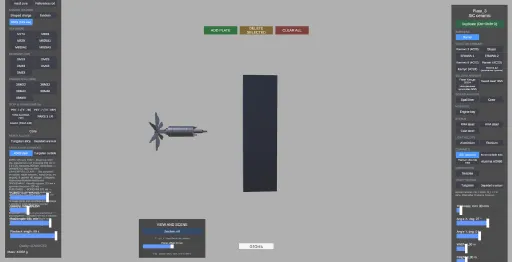
Free-build scene editor — add, drag, rotate and re-material plates; spaced and layered stacks
An extensive material database: 14 armour materials and 4 penetrator cores
Kinetic penetrators drawn from American, Soviet/Russian and German service ammunition
Reactive armour, ceramic with backing, composite backing plates
Shaped-charge jets at normal incidence
Slow-motion playback with a free orbit camera
Shareable replay files — a full ULTRA run is a couple of megabytes
Five interface languages: English, Русский, Deutsch, Polski, Татарча
Who this is for
If you have ever paused a documentary to argue about whether that shot should have gone through — this was built for you. No engineering degree required, and no engineering software to learn. Set it up, hit fire, watch it happen.
Screenshots
10 images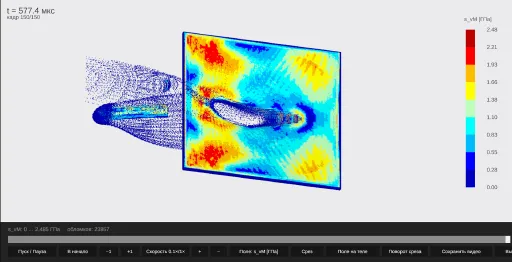
Version Information
Steam Patch Notes
Official update history
The Plane (2D) mode no longer requires the DLC — it is open to all. A warning is shown before entering: the mode is unfinished and released for alpha testing.
RADARSIM is free as well: map, target routes and altitudes, ground radars, and a conditional launch against an observed track.
Simulation recordings are much smaller
New tape format with on-the-fly compression. Measured on real recordings: 2.5–6× smaller, up to 11.8× on some scenes. The heaviest recording on disk: 5.1 GB → 969 MB.
Compression is on by default; nothing to configure.
SUPER optimisation
Memory per recorded frame: 356 → 213 MB.
Freeze while recording: 22.5 s → 0.28 s.
The sparse grid is now the default — less video memory for the same scene.
Materials and rounds
Neoprene now has its own material row (Millett, Bourne & Akhavan 2004 Hugoniot) — previously it was treated as polyurethane.
Depleted uranium DU-0.75Ti is simulated in SUPER (Johnson & Cook 1983 flow).
NERA interlayers: polyurethane, neoprene, natural rubber.
Other
Steam Workshop: upload and download armour layouts; a snapshot of the layout is attached to the item.
Reworked controls: wheel, orbit camera, side panel scrolling.
The menu now shows the real build version.
Current Release
Build 25851322
Uploaded Oct 10, 2026
System Requirements
How to Install
ArmorSim.exe to play
Troubleshooting tips
• Run Redist/_CommonRedist installers if game won't start
• Add folder to Windows Defender exclusions
• Run as administrator
Download
Direct link available
Needed when extracting (WinRAR / 7-Zip) — not a site login.
B9AC6EDD
f008c8dc2eda5ea5016c25b883a66c600ebf499e8c9c7993c58f5570631d5832
You May Also Like
View All





Download ArmorSim for PC with a direct link or via torrent. Get the full version of ArmorSim for free. ArmorSim is a Indie released by Timerlan Galimov.