








About the Game
One empty floor. One client. Build it into the backbone of the cloud
You begin with a bare room and a single server you assembled by hand. Grow it into a sprawling enterprise data center: rows of hundreds of racks, redundant power and networking, massive storage fabric, and a steady stream of clients pushing heavy workloads across hardware you designed yourself every day.
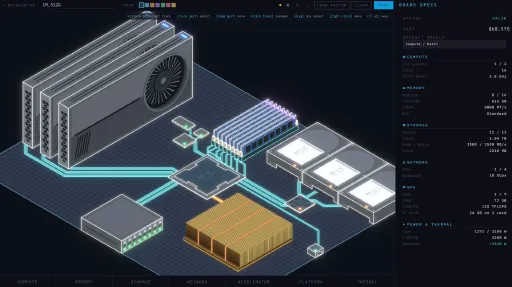
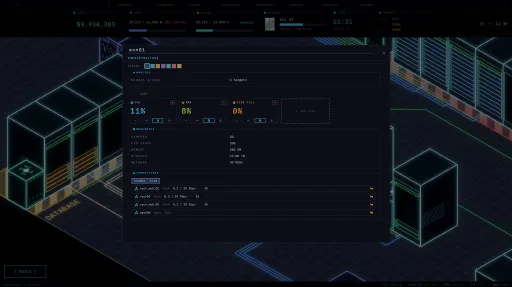
Design your own servers
You do not buy servers off a shelf. You build them.
Choose every piece of hardware and where it goes: processors, memory, storage drives, network cards, GPUs, and enterprise AI accelerators, each with its own cost, performance, and power draw.
Build the right server for the work. A server tuned for log processing is wasted money on an AI training run.
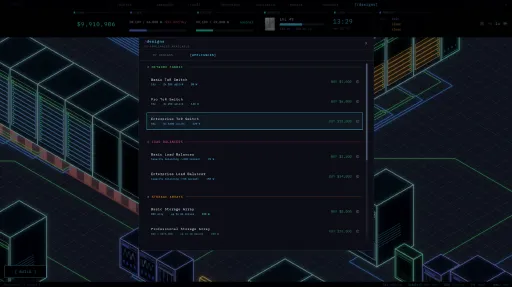
Unlock new chassis, board form factors, appliances and more as you grow, from compact single socket nodes to dense intertwined GPU, CPU and storage clusters.
Build out the facility
A great server is nothing without the room around it, and this is where the real engineering begins.
Lay out your floor rack by rack and slot your servers into place.
Feed them power through UPS units and distribution panels, but mind your circuits, because a single overloaded run can make an entire aisle of servers go dark.
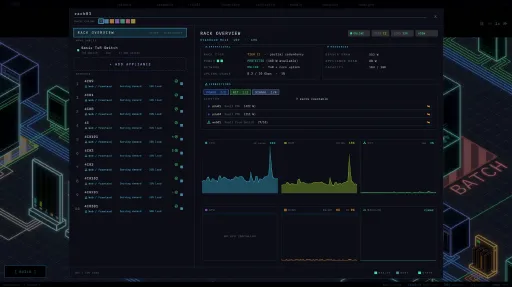
Stitch it all together using network appliances and cables, storage fabrics and more to form the networks and clusters each workload demands.
Sign clients. Deliver uptime
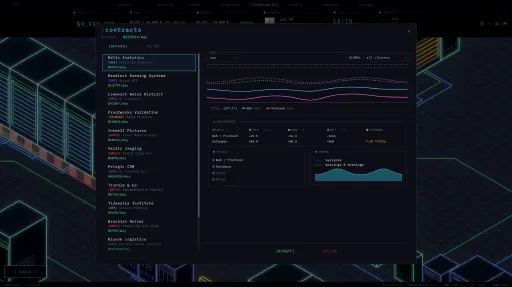
Customers arrive with real workloads: web hosting, video rendering, cold storage, financial trading, cloud gaming, and more. Take on what your hardware can actually deliver, place it on the right server, and collect the revenue. Staying online is the hard part.
Hardware wears out and fails. Storage drives die, and the RAID level you chose decides whether that is a minor event or a data loss disaster.
Fall behind on the power bill and the utility starts cutting your supply.
Hire technicians to repair and maintain the floor once it grows beyond what you can manage on your own.
Hyperscale
Tie dozens of racks together into a single compute cluster for specialized and lucrative high performance workloads requiring thousands of CPU cores.
Stand up GPU clusters for AI training and inference, the workloads everyone is racing to host.
Pool storage across racks into massive petabyte sized pools. Don't forget to protect yourself by configuring your drive arrays properly and setting up replication mirrors for redundancy.
Your job as the datacenter architect is to balance system load, uptime, cost, and resiliency to keep your clients happy.
Run it your way
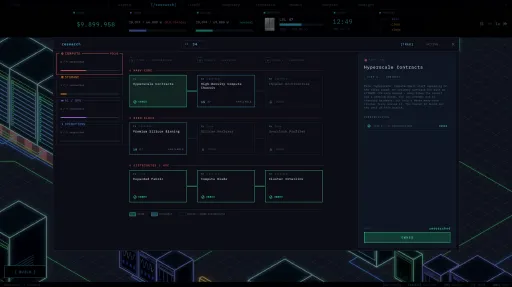
A limited research budget and four specialization paths (Compute, Storage, AI, and Operations) mean every facility you build turns out different. Go all in on raw compute, become a storage provider, chase the AI boom, or squeeze every watt and every dollar with operational efficiency.
Built for the IT minded
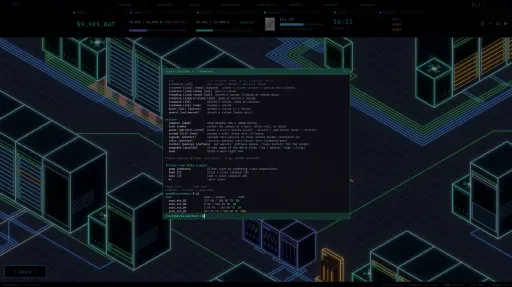
If you have ever racked a server, argued about RAID levels, or run a home lab just because you could, this one is for you. Name your servers, query your fleet, and fire off batch commands from the built in terminal CLI if you are an experienced tech. It is the data center you always wanted to run, without the noise, the heat, or the power bill.
Features
Build servers part by part, balancing performance, power, and cost
Plan a real facility: power, networking, cooling, and structured cabling
Manage system configurations in detail to create complex clusters and networks
Dozens of client workloads, from quick batch jobs to long term tenants paying daily
A living simulation of hardware faults, drive failures, power crises, and repairs
Compute clusters, GPU and AI systems, and multi rack storage at the high end
Four specialization paths that reshape how your facility grows
100 operator ranks of new hardware and capabilities
An optional command line terminal for power users
Single player, played at your own pace
Wishlist Dead Sector and start planning your floor.
Screenshots
8 images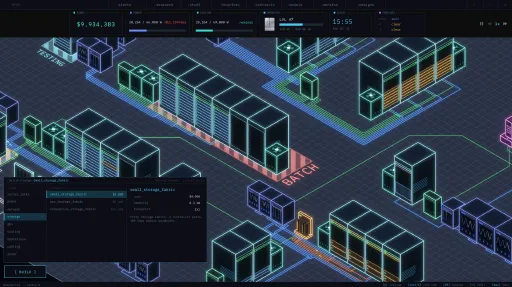
Version Information
Steam Patch Notes
Official update history
Demo v0.1.2 fixes a few bugs and issues and adds a few new features.
Added:
Initial version of contract load profiles which help gauge capacity when accepting new contracts. Further improvements to this are planned in the future.
Added automatic scaling of CPU requirements based on current clock speeds to better communicate required resources when servers with mixed and varying CPU clock speeds are deployed.
Added time scale control up to 5x and pause functionality.
Added the ability to sell appliances and infrastructure items from storage.
Fixed:
Fixed an issue where service action did not show when a fault occurred on a server that was actively selected in the UI.
Fixed an issue where notification text was clipping within the UI.
Fixed an issue where moving a contract to a different cluster while the servers had dual network feeds would cause the network core switch to read idle. This item is part of a larger rework of the dual network feed and failover system planned for a future update.
Fixed an issue with cooling unit descriptions in the build menu.
Current Release
Build 26415253
Uploaded Nov 06, 2026
System Requirements
How to Install
Dead Sector.exe to play
Troubleshooting tips
• Run Redist/_CommonRedist installers if game won't start
• Add folder to Windows Defender exclusions
• Run as administrator
Download
Direct link available
Needed when extracting (WinRAR / 7-Zip) — not a site login.
You May Also Like
View All









Download Dead Sector for PC with a direct link or via torrent. Get the full version of Dead Sector for free. Dead Sector is a Indie released by Lonely Cloud.