









About the Game
Family Office Simulator is a deep, aspirational wealth-building strategy sim that puts you behind the desk of your own private family office.
Acquire income-producing real estate, manage debt and liquidity, build operating entities, hire staff, structure trusts, and grow a family institution designed to last beyond one founder.
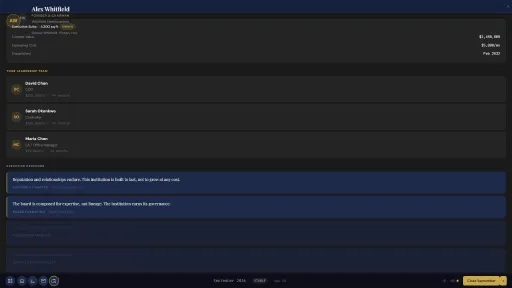
Built around a polished desktop OS interface, Family Office Simulator lets you operate through the apps and workflows of a modern financial office: banking, mail, property management, accounting, brokerage, HR, foundation management, and more.
This is not just a clicker or idle tycoon. It is a strategy simulation about the machinery behind wealth: capital, leverage, cash flow, reputation, governance, succession, and time.
Build a Real Estate Empire
Source deals through a commercial real estate marketplace
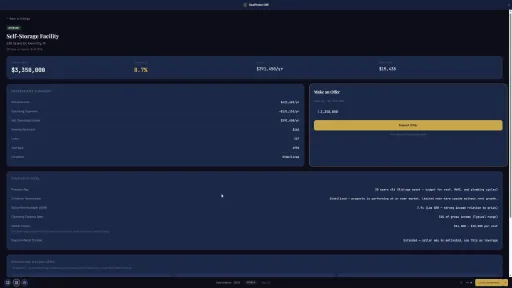
Review cap rates, NOI, financing needs, debt service, and cash required to close
Negotiate offers with counter-party logic
Acquire, operate, refinance, and sell multifamily, storage, commercial, and NNN properties
Navigate market cycles including boom, stable, correction, and crash environments
Run a Multi-Entity Family Office
Form and manage LLCs, operating companies, holding structures, trusts, and philanthropic vehicles
Track cash flow, P&L, debt, payroll, taxes, reserves, and software subscriptions
Build an HQ and expand staff capacity as your office grows
Use governance, reputation, and capital structure to shape the long-term direction of the institution
Hire and Manage Your Team
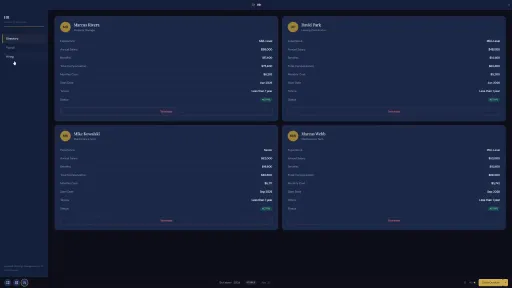
Recruit leasing, maintenance, accounting, operations, and executive staff
Manage payroll, benefits, and quarterly payroll taxes
Respond to staff-generated decisions that affect rent, expenses, vendors, tenants, and office performance
Build the team your growing portfolio needs
Operate Like a Real Family Office
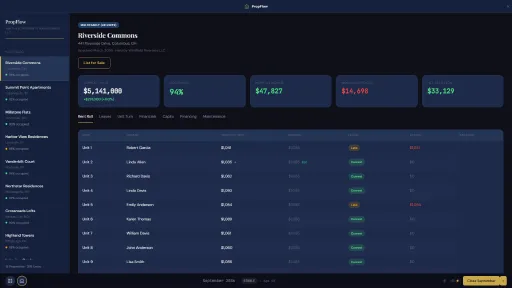
Use a full suite of in-game apps: Banking, Mail, Property Management, Accounting, Brokerage, HR, Foundation, and more
Make monthly decisions with financial consequences
Manage philanthropy through a Legacy Foundation and Donor-Advised Fund
Review your progress through monthly reports, year-end summaries, and long-term institutional milestones
Plan for succession as your founder ages and the family office grows beyond one generation
Authentic. Aspirational. Deep.
Family Office Simulator is built for players who want more than a simple tycoon game. It is for players who want to understand and operate the systems behind wealth creation: acquiring assets, managing capital, protecting liquidity, building teams, and turning personal wealth into a lasting institution.
If you have ever wondered how a family office actually works, now you can run one.
FEATURE LIST
Realistic multi-entity wealth management
Full property acquisition and operations pipeline
Multifamily, storage, commercial, and NNN property modeling
Banking, debt, refinancing, and liquidity management
HR, payroll, and staff lifecycle systems
Trust, succession, and philanthropy systems
Market cycle engine
Monthly simulation with real financial consequences
Accounting, P&L, cash flow, reserves, and capital structure tracking
Negotiation, decision systems, and staff-driven events
Authentic software-style UI across all apps
Save/load with migration support
Steam Cloud support
Ambient office atmosphere and polished desktop OS
Screenshots
6 images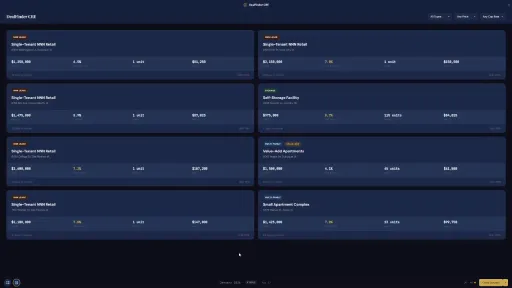

Version Information
Steam Patch Notes
Official update history
Today's Family Office Simulator update brings two player-requested improvements to New Game.
**CHOOSE YOUR FOUNDER'S STARTING AGE**
You can now select your founder's starting age instead of relying entirely on a random result.
- Choose any whole-number age from 25 to 70.
- Available across The Grind, The Inheritance, and The Windfall.
- Prefer a surprise? The Randomize button is still there.
- Your selected age is displayed before you launch your family office.
Starting age also affects the existing succession timeline. A younger founder has more potential time to establish the office, while an older founder may need to think about succession much sooner.
**REMEMBERED FOUNDER NAMES**
New Game can now remember the first and last names from your last successfully created founder on that device.
- Names automatically appear the next time you start a new campaign.
- Both names remain fully editable.
- Use Clear remembered names whenever you want to start fresh.
**EXISTING CAMPAIGNS**
Your existing saves, founder ages, and identities are unchanged. You do not need to restart an existing campaign to continue playing.
These new customization options apply when creating a new campaign. Starting cash, banking terms, and the underlying financial simulation have not been changed by this update.
The release was tested through the private Steam branch, including Steam launch, overlay, New Game, Save, Quit, restart, and Continue.
**Public BuildID: 26086237**
Thank you to everyone who keeps sharing feedback and suggestions. I appreciate it, and I'm continuing to work on making Family Office Simulator more realistic, useful, and enjoyable.
If you run into a problem, please let me know on Steam or contact [email protected].
Another Family Office Simulator update is here!
This release focuses on making important financial decisions easier to understand, correcting a frustrating Line of Credit situation, and improving how succession information is presented.
The goal is simple: when you make a financial decision, the game should show you what it means, apply the consequences consistently, and never penalize you for already doing the right thing.
## LINE OF CREDIT — SEE THE COST BEFORE YOU BORROW
The Banking app now shows a detailed interest preview when drawing from your Line of Credit.
Before confirming a draw, you can see:
- Your proposed draw amount.
- Current and projected LOC balances.
- Current and projected monthly interest.
- The additional monthly interest created by the draw.
The estimate uses your current modeled LOC rate and the game's existing monthly interest calculation, including its rounding behavior. It is a monthly estimate, not a binding or prorated quote.
You can now compare the borrowing cost against your expected cash flow without having to calculate it separately.
## FAIRER LOC CRISIS DECISIONS
We've corrected two issues involving Line of Credit repayment warnings.
**Repayments must actually be affordable.**
An LOC repayment offered through a crisis message now follows the same Checking-balance and repayment safeguards as Banking. An unaffordable payment is refused without moving money or falsely completing the decision.
**Already met the repayment goal? You shouldn't be punished.**
Previously, a player could receive an LOC warning, repay the debt directly through Banking, and still be left with a pending advisory demanding the original repayment. Close Month could then remain blocked unless the player accepted an unnecessary reputation penalty.
When the existing advisory's repayment goal has already been satisfied, it can now be explicitly closed without another payment or the reputation penalty.
The underlying LOC limits, rates and crisis rules have not been relaxed.
## SUCCESSION — CLEARER FINANCIAL DISCLOSURES
Succession can have major financial consequences, and the game needs to explain them accurately.
The Reading now gives greater prominence to the recorded settlement charge, the financial basis, and the modeled terms.
We've also clarified that FOS uses a simplified succession settlement model. Its charge is not a calculation of actual estate taxes or probate expenses, and establishing a trust does not automatically eliminate every real-world estate obligation.
These improvements clarify the existing model rather than changing established succession economics or rewriting historical transactions.
## INTERFACE & ACCESSIBILITY IMPROVEMENTS
We've also improved several parts of the experience:
- Better keyboard focus and navigation in Banking and Succession dialogs.
- Clearer payment-refusal messages beside the decisions they affect.
- Improved text contrast, spacing and readability.
- A more readable financial hierarchy during The Reading.
- Better usability across supported UI scaling options.
These changes preserve the existing visual identity of Family Office Simulator while making important actions easier to follow.
## EXISTING CAMPAIGNS
**Existing saves remain supported. No new campaign is required.**
This update has been independently reviewed and tested for financial consistency, save integrity and progression behavior.
The final Windows release candidate was also tested through Steam, including launch, overlay, Banking draws and repayments, transaction history, saving, quitting and restarting.
The changes address specific problems; they are not a claim that every possible historical save or financial edge case has been eliminated.
If you run into a problem, please include the exact error, your in-game date and your Steam BuildID. Please preserve your original save, and send private save exports to [email protected] when needed.
**Steam BuildID: 26082730**
Thank you for continuing to play, share suggestions and report problems. That feedback makes a real difference.
I'm continuing to work toward deeper management gameplay and a family office that stays enjoyable as your organization grows.
**Vitalis Interactive**
Today's Family Office Simulator update adds more meaningful property-management choices, improves how agreements are presented, and delivers a Banking quality-of-life feature requested by a player.
## PROPERTY MANAGEMENT AGREEMENTS
DwellingDesk now offers differentiated contracts from three property-management companies:
- **Marsten Property Operations:** Lower recurring cost and broad capacity, with less intensive leasing follow-up.
- **Larkin Residential Services:** A middle ground between service intensity, capacity and cost.
- **Verren & Hale Property Management:** More intensive follow-up for smaller vacancy groups, at a higher price.
Each company offers two agreements:
- **Standard:** A 12-month-close initial commitment and two full closes' ordinary notice.
- **Turnaround:** A four-month-close initial commitment and one full close of ordinary notice, at a higher recurring fee.
These are real modeled tradeoffs. Higher prices don't guarantee tenants or better results, and the companies have different limits on how much leasing follow-up they can provide.
The redesigned agreement screens now make fees, covered properties, commitments, notice periods and potential early-exit costs easier to understand before you commit.
Existing third-party arrangements continue under their previous fee-only terms until you explicitly accept a new agreement. Your existing campaign does not need to be restarted.
## BANKING — MAX TRANSFERS
Thanks to a player suggestion, Banking now includes a **Max** button when transferring money between Checking and Savings.
- Works in both directions.
- Fills the available transferable amount without sending money immediately.
- Lets you edit the amount before confirming.
- Keeps the existing balance checks and transaction records.
It's a small change, but one that should make moving money around much less tedious.
## SAVE COMPATIBILITY & RELIABILITY
The update also includes protection for supported older saves moving into the new management-contract format, preserving original pre-upgrade save information locally before the first qualifying replacement.
The new build was tested through Steam with contract acceptance, Save/Quit/Continue, Banking transfers, Steam overlay and Cloud synchronization.
Existing campaigns remain supported. No new game is required. As always, please keep backups of important saves.
## WHAT'S NEXT?
I'm continuing to focus on meaningful management decisions and reducing repetitive administrative work as your family office grows, while keeping financial consequences grounded in the simulation.
Thank you for the continued feedback and support. It genuinely helps shape where the game goes next.
— Vitalis Interactive
**Steam BuildID: 26050913**
Another Family Office Simulator update is here!
This one includes some important work on existing saves and financial reliability, along with new tools for managing your family office.
A player recently contacted me because their existing campaign would no longer load. They sent over their save, and I was able to trace the problem to a mortgage payoff calculation that could leave a tiny floating-point difference in the financial records.
That sounds minor, but when you're dealing with a game that tracks money and transactions over decades, those differences matter.
I'm happy to say the correction is complete, and I successfully tested recovery of the affected campaign through the Steam-installed game.
## EXISTING SAVE RECOVERY & MORTGAGE PAYOFFS
- Corrected mortgage payoff calculations to maintain exact-cent financial balances.
- Added recovery support for certain older saves affected by the historical payoff issue.
- Preserved mortgage obligations, payment history and financial transaction records during supported recovery.
- Verified that the affected player's campaign could be imported, saved, closed and reopened successfully.
Recovery still requires consistent financial evidence. The game will not invent missing transactions or silently change unsupported financial history.
## LONG-TERM FINANCIAL RELIABILITY
I also addressed another issue that could affect campaigns running over many in-game years.
Some older transactions eventually leave the game's active financial journal while their associated mortgage or settlement records remain. Under specific circumstances, a new transaction could reuse one of those historical IDs, leaving the saved campaign unable to load correctly.
Transaction ID allocation now accounts for those retained records across Banking, lines of credit, expenses, HQ operations, property sales and other financial workflows.
The goal is simple: legitimate financial activity shouldn't leave you with a campaign you can't continue.
## UPCOMING CLOSE CASH OUTLOOK
Accounting now includes an Upcoming Close Cash Outlook to help you understand the cash expected to come in and go out when you advance to the next month.
The outlook distinguishes modeled cash movement from less certain items rather than presenting every estimate as guaranteed money.
It's intended to give you a clearer picture of your commitments before you make another major financial decision.
## EMPLOYEE REPLACEMENT POLICIES
I've expanded staffing management with replacement policies for named operational roles.
This gives you more control over how vacancies are handled as your organization grows, while keeping hiring qualifications, compensation and delegated spending authority part of the decision.
Managing a larger institution should increasingly be about setting good policies, not endlessly repeating the same manual tasks.
## 1031 EXCHANGE CLARITY
I've also improved the way usable 1031 exchange proceeds and deadlines are presented.
Expired exchange opportunities should not appear as though their proceeds are still available for a new qualifying acquisition.
The display now better reflects the underlying exchange rules without changing the established transaction economics.
## EXISTING CAMPAIGNS
You do not need to start a new campaign to benefit from these changes.
If you've been unable to load an existing save, update through Steam and try again. Please keep your original exported save as a backup.
Not every possible historical save problem is covered, and there is still more reliability work to do. These corrections address specific reproduced issues without broadly rewriting financial history.
**Steam BuildID: 25945206**
If you encounter another problem, please contact **[email protected]** with the exact error, your Steam BuildID and an exported save if available.
Thank you to everyone who's been playing, reporting issues and sharing feedback. I genuinely appreciate it. Some of these fixes take a surprising amount of digging, but getting the financial systems right—and protecting the time you've invested in your campaigns—is worth it.
More to come!
**Vitalis Interactive**
October 13 - Brokerage Accuracy & Financial Integrity Update
Another Family Office Simulator update is live!
This one focuses on two things that are especially important in a financial simulation: making sure the numbers are right and making sure legitimate financial activity doesn't create problems later in your campaign.
BROKERAGE COST BASIS & CAPITAL GAINS
I've corrected how Brokerage calculates the cost basis of shares purchased at different prices.
Previously, when you bought shares at slightly different prices, the game could use a rounded average share price when calculating the cost basis of a sale. That rounding could create differences between what you actually invested and what the game treated as your original cost.
Those differences could also affect calculated capital gains and the game's tax withholding, particularly with larger positions.
That's been corrected.
Brokerage sales now use the position's actual retained cost basis rather than reconstructing it from a rounded average price.
Partial sales allocate the original cost basis consistently.
Selling the remaining shares uses the exact remaining basis.
Sale previews and completed transactions use the same financial calculation.
Realized gains, modeled tax withholding, cash proceeds and remaining position values stay consistent.
The game's existing simplified 20% withholding on positive capital gains has not changed. This update corrects the calculation underneath it.
FINANCIAL TRANSACTION RELIABILITY
I've also strengthened how the game creates and tracks financial transaction identities.
In longer campaigns, older financial records can remain important even after the regular transaction history has been shortened. Under certain circumstances, a new transaction could be assigned an identity that conflicted with one of those retained records.
That could eventually cause Close Month to reject an otherwise legitimate financial history.
New financial transactions now check the relevant retained identities, not just the transactions currently visible in the ledger.
This applies to several important financial operations, including Brokerage activity, dividends, property acquisitions, financing-related charges and certain 1031 exchange refunds.
The goal is to prevent new identity conflicts without weakening the checks that protect your financial records.
EXISTING SAVES & TESTING
You do not need to start a new campaign.
This update does not rewrite your historical financial transactions or previously completed trades. The corrections apply to new financial activity as you continue playing.
The update went through independent review, exact-cent financial testing, long-history compatibility checks, Close Month testing and packaged Windows validation.
I also tested the actual Steam-installed release candidate with an existing campaign, including Banking, Brokerage, saving, fully quitting, relaunching through Steam and continuing successfully.
There is still work to do. This doesn't mean every unusual save, Steam Cloud or historical financial issue has been resolved.
If something doesn't look right, please let me know. The exact error, in-game date and an exported save are especially helpful. You can send private exports to
.
WHAT'S NEXT?
I'm continuing to work on making the underlying systems more dependable, but I also want to keep moving Family Office Simulator forward.
That includes deeper financial planning, more meaningful management decisions and reducing repetitive work as your family office grows.
The goal is a game that becomes more interesting as your organization gets larger, while keeping the financial and operational consequences grounded in the simulation.
Steam BuildID: 25891418
Thanks again for playing, reporting issues and helping shape the game. I appreciate it!
Vitalis Interactive
Another Family Office Simulator update is live!
This one focuses on something I take pretty seriously: protecting the time you've invested in your family office.
While investigating some save reliability edge cases, I found situations where a save file that couldn't be read properly could appear to the game as an empty slot or an incomplete deletion. That could lead to the wrong options being offered, including creating a new campaign where an existing one was still present.
I've made several changes to address those situations.
### SAVE SLOT PROTECTION
- Save files that cannot be read or verified now show **Save Unavailable** rather than being treated as empty.
- New Game and Import now use protected save creation that refuses to overwrite an existing save file.
- Delete now verifies that the save still matches the one you selected before proceeding.
- Retry Delete no longer assumes that an unreadable file has already been deleted.
- Additional protections prevent older storage operations from bypassing these checks.
### NEW GAME & IMPORT RECOVERY
I've also fixed a related problem where a new campaign could get stuck in a Retry Launch loop.
If another save occupies the selected slot, the game now explains what happened and returns you to the Main Menu instead of repeatedly telling you to retry or check your disk space.
Import has received the same protection, along with improvements to prevent an outdated import operation from interfering with a newer screen.
A genuine first-save failure that can safely be retried still preserves the original campaign instead of rebuilding it.
### WHAT IF YOU SEE "SAVE UNAVAILABLE"?
It means the game could not safely verify the save slot or its index.
The game will avoid offering actions that could replace or delete the save while its status is uncertain.
You can use **Check Again** or restart the game if the underlying issue has cleared. If the message persists, please contact me before trying to replace or delete anything.
### EXISTING SAVES
**You do not need to start a new campaign.**
This update does not rewrite your existing campaign history or change the game's financial simulation.
The changes were tested through the packaged Windows application, including existing saves, New Game, Import, deletion safeguards, Save, Quit, Continue, and Steam-specific launch testing.
This does not mean every possible save problem or Steam Cloud conflict has been solved. There's still more reliability work to do, especially around unusual filesystem and older-save situations.
If you run into a problem, please preserve your original save and send the details to **[email protected]**. Screenshots, the full error message, and your installed Steam BuildID are especially helpful.
Thanks to everyone continuing to support Family Office Simulator and report problems. Some of these issues take quite a bit of digging to reproduce, but protecting your campaigns and getting the underlying systems right is worth the work.
More improvements are on the way.
**Vitalis Interactive**
Another Family Office Simulator update is here!
This one addresses two problems involving the start of a new campaign: the financial accuracy of inherited mortgages and what happens when the game's first save doesn't complete successfully.
## INHERITANCE MORTGAGE ECONOMICS
I've corrected how the starting mortgage is calculated when you choose The Inheritance.
Previously, some of the starting mortgage numbers weren't lining up correctly. The original loan, remaining balance, monthly payment, and early payoff calculation were using inconsistent assumptions.
That's been corrected.
- Inherited mortgages now reflect their original January 2023 loan, with the payments made before your campaign begins accounted for.
- The outstanding balance and monthly payment now follow the same amortization schedule.
- The immediate payoff option now uses the actual contractual 2% prepayment penalty in January 2026 instead of the previous 4% charge.
- Both Assume Mortgage and Pay Off Mortgage use the same underlying loan economics.
- The January 2030 balloon payment and associated risk are explained more clearly during setup.
The goal is pretty simple: choosing whether to keep the mortgage or pay it off should be a real financial decision based on consistent numbers.
## NEW GAME SAVE RELIABILITY
I also corrected an issue with Retry Launch when the initial save of a new campaign failed.
Previously, trying again could recreate the starting campaign in memory instead of simply retrying the save. That could leave the player stuck in a retry loop.
Now:
- A new campaign is constructed only once.
- Retry Launch preserves the original campaign and its financial state.
- A confirmed failed write can be retried without recreating properties, companies, or financial transactions.
- Uncertain save outcomes remain protected rather than risking an unsafe duplicate operation.
- All four starting routes, including both Inheritance choices, have been covered in testing.
## TESTING & SAVE COMPATIBILITY
This update went through financial reconciliation, save/reload testing, Windows application testing, independent review, and private Steam testing.
I also expanded our internal regression coverage for financial processing and save reliability.
**Existing saved games remain supported.** The corrected starting inheritance mortgage calculations apply to newly created campaigns. I'm not rewriting existing players' historical mortgages or financial transactions.
Thanks again to everyone playing, reporting issues, and helping improve Family Office Simulator.
I want the financial systems to be accurate, the game to be reliable, and every update to leave things better than they were before.
There's more work ahead, both on the underlying game systems and on making the family office deeper and more enjoyable to manage.
Thanks for being part of it!
Vitalis Interactive
Another Family Office Simulator hotfix is live.
This update addresses several issues that could leave players stuck in an existing campaign, particularly around refinancing, closing a month, and handling financial transactions.
A couple of players sent me their actual saved games, which helped uncover problems that were not showing up through ordinary gameplay testing.
## REFINANCING & HISTORICAL MORTGAGES
- Fixed a case where an inherited mortgage created by the game could incorrectly be treated as invalid because its original loan date was earlier than the simulation's starting year.
- Refinance options now display actual loan terms instead of showing everything as Unavailable for that affected mortgage history.
- Genuine lender restrictions, including DSCR and minimum-loan requirements, still apply and display their reasons.
- Corrected refinancing-window behavior that could leave Select or Cancel unusable.
- Fixed a separate financial-precision issue that could prevent a legitimate refinance on a longer-running save.
- Existing mortgage history and completed transactions are preserved rather than rewritten.
## CLOSE MONTH & CAMPAIGN PROGRESSION
Fixed a month-close issue affecting certain existing campaigns with legitimate financial history and balances containing cents.
In the affected case, the month-close animation could start and then return an error asking the player to reload, with the same error appearing on every attempt.
The corrected build now completes that month and allows the campaign to continue.
## BANKING
Banking now handles decimal amounts correctly in transfers and Line of Credit operations.
For example, entering **$1,000.50** now means exactly $1,000.50. It should no longer be silently interpreted as $100,050.
Invalid number formatting is rejected instead of being turned into a different transaction amount.
## EXISTING SAVES & TESTING
**You should not need to start a new game.**
I tested protected copies of the actual saves that helped expose these issues, including refinancing, Close Month, later-month progression, saving, fully quitting, restarting through Steam, and continuing the same campaign.
The final packaged build also went through financial reconciliation and independent review before being tested on Steam and promoted publicly.
If you were stuck, let Steam download the update and try your existing save again.
If something still fails, please send the exact error message, in-game date, and an exported save to **[email protected]**. Please keep your original export as a backup.
**Steam BuildID: 25842290**
Thanks again to everyone who has taken the time to report bugs, send screenshots, and share saves. I know how frustrating it is to spend hours building a family office only to have a legitimate action stop working.
Those reports are helping make the game better, and I'll keep working through them.
Thank you for playing Family Office Simulator!
Another Family Office Simulator hotfix is live.
This one addresses something I take seriously: players being unable to continue an existing campaign because a legitimate financial transaction or property closing gets blocked.
A couple of players sent me their affected saves, and those reports helped track down several problems that ordinary testing had not fully exposed.
**ACREPILOT CLOSING CORRECTIONS**
- Corrected a case where an already accepted financed closing could be blocked after another property was acquired, even though the agreed financing terms were still valid.
- Fixed checking-balance precision issues that could develop after certain property sales or capital improvements and prevent otherwise valid cash or financed purchases.
- Preserved the existing lender eligibility, cash requirements, accepted terms, transaction checks, and protections against duplicate closings.
**BANKING & EXISTING SAVE RECOVERY**
- Corrected an HQ financial calculation that could leave a legitimate checking balance in an unsupported state.
- Added narrowly verified recovery for affected older saves when the retained transaction history proves the correct balance.
- Strengthened HQ purchase and upgrade calculations to prevent the same type of problem going forward.
The recovery does not guess at missing financial history or rewrite transactions when there is not enough evidence to verify them.
**EXISTING SAVES**
You should not need to start a new campaign for these corrected cases.
Before releasing this update, I tested the actual saves supplied by two affected players through the Steam-installed build.
One previously inaccessible save imported successfully and retained its financial state through multiple Save, Quit, and Continue cycles.
The other resumed a previously blocked property closing, completed the acquisition, and retained the newly owned property after saving and restarting.
Those tests are encouraging, but they do not mean every possible older save issue has been resolved.
If you were affected, please update the game and try your existing save again. Keep your original exported save as a backup.
If something still fails, please send the full error screenshot and an exported save to [email protected].
Thank you to everyone who has taken the time to report problems and send saves. I know it's frustrating when a campaign you've invested time in stops working, and I appreciate you giving me the information needed to investigate it properly.
I'll keep working to make Family Office Simulator better.
What changed:
• Previously accepted financed closings can now continue when the agreed financing terms are still valid.
• Current lender eligibility, loan terms, cash requirements, and settlement checks are still revalidated before the purchase closes.
• Existing affected saves do not need to be restarted.
• Save and retry protections remain in place.
If you are still seeing a property purchase blocked after updating, please post the full in-game error message in Discussions so I can compare it to the case we fixed.
Thanks to the player who reported this.
This one is focused pretty heavily on what happens as the family office gets bigger. More staff, more properties, more debt, and more routine operating work should not automatically mean more clicking just to keep the place running.
MAINTENANCE SUPPORT TEAMS
Larger offices can now build a Maintenance Support Team under an experienced Maintenance Tech.
Support positions are real paid capacity. They have recruiting costs, ramp into full productivity over time, affect payroll and workload, and can experience turnover just like the rest of the organization.
The first version is intentionally bounded. You still decide when to build the team and how much capacity you want rather than the game silently hiring people for you.
ACTIVE MORTGAGE LEDGER
Sumtrail now includes a centralized Active Mortgages view.
Instead of digging through individual properties to figure out what debt is still outstanding, you can now review active property mortgages in one place, including:
• current balance
• interest rate
• scheduled payment
• maturity
• remaining months
• lender and property
• upcoming maturity urgency
You can search, filter and sort the ledger, and identified mortgages can take you directly to that property's Financing screen.
UNIT TURN AUTHORITY
HR now has portfolio-level operating policy for automatic Unit Turns.
In-house automatic turns require the Property Manager operation to actually be ready and have available capacity. Property Management also has a Unit Turns worklist showing the current backlog, what can be handled automatically, and what still needs owner attention.
The goal here is not to make the game play itself. Routine work should be delegatable when you have actually built the staff and capacity to support it, while exceptions still come back to you.
COMPENSATION REVIEW DESK
HR now has a dedicated Compensation Review Desk for employee compensation decisions.
You can compare the actual loaded cost of approving a review against holding compensation where appropriate, see the retention implications the current model can actually support, and work through reviews without hunting through separate message threads.
There is also an Approve All option for eligible reviews when you want to clear a group together.
I gave this screen a visual pass as well. The primary actions, supporting information and summary area should be much easier to read without turning HR into a giant wall of buttons.
DECISION EXPENSE SAFETY
I also found some older decision-expense logic that was much looser than I was comfortable with.
Repair, replacement and liability-related decisions now have stronger checks around available cash, the property or obligation they belong to, transaction identity, reporting and save/reload behavior.
A maintenance decision tied to a property that is no longer owned will not just charge the company anyway. Verified historical liability obligations still remain obligations after a property sale.
Older save decisions that do not contain enough reliable information to prove what the charge belonged to now fail closed instead of guessing and taking money.
There is also protection against a zero-cash dead end. If every valid option on one of these decisions is currently unaffordable and there is no non-cash choice available, the unresolved obligation can carry forward rather than trapping the campaign before incoming cash can arrive. It remains pending and becomes actionable again when the office has the liquidity to deal with it.
EXISTING SAVES
Existing saves are supported. You do not need to start a new game.
I also tightened the previous-public save test matrix for this release so older schema saves are explicitly tested through the current migration and save/reload path instead of just assuming the old state should behave exactly like current code.
The exact Steam build was tested privately before promotion, including Steam launch and overlay, loading an existing save, making a real state change, quitting completely, relaunching through Steam and confirming that change persisted.
As always, if something looks wrong, tell me. Screenshots help, exported saves help even more, and the weird long-running saves continue to be some of the best testing material I can get.
Thanks for continuing to play and point out the stuff that needs work.
This one focuses on a few places where running a growing family office was creating more friction than it needed to, especially around recruiting, staff departures, and figuring out which property needs attention when a mortgage reaches maturity.
RECRUITING
Recruiting searches now behave more like an actual candidate slate instead of a button that keeps generating replacements.
• If you hire one candidate from a valid recruiting search, the other candidates remain available.
• Hiring someone does not immediately refill the slate with new candidates.
• Candidate slates remain available for a limited period rather than disappearing after a partial hire.
• Direct Search charges its $750 search cost once when the search is opened.
• Agency recruiting charges its placement fee based on the candidates you actually hire.
The goal here is pretty simple: if you paid to find a group of candidates, hiring one of them should not throw away the rest of the search or quietly generate a fresh batch.
STAFF DEPARTURES
Staff departures should also be much harder to miss.
When an employee voluntarily leaves, Close Month now gives that departure proper visibility instead of allowing an important staffing change to get buried in everything else happening that month.
HR wording around current and completed staffing changes has also been tightened up so the game is clearer about what actually happened and what still needs your attention.
This is not the end of the work I want to do around larger offices and late-game staffing. Several players with mature family offices have correctly pointed out that hiring, routine approvals, compensation reviews, and replacement staffing can turn into too much monthly click-work as the organization gets larger.
I agree with that feedback, and I am working through it carefully rather than solving it with a giant "automate everything" button that removes the management game.
MORTGAGE MATURITY NAVIGATION
This came directly from a recent player suggestion.
When a new mortgage-maturity warning identifies a specific active loan that needs attention, the warning can now take you directly to the correct property's Financing screen.
You should no longer have to remember the loan, close the warning, search through a large portfolio, find the property, and then work your way back into Financing just to deal with a balloon maturity.
The game rechecks the property and mortgage when you use the action. If the loan has already been paid off, refinanced, replaced, or the property has been sold, it will not guess and send you somewhere incorrect.
Older historical warnings also do not receive invented links when the game cannot safely prove which current financing state they should point to.
HR TERMINATION
I also corrected an HR edge case where a termination confirmation could become stale after the underlying employee state changed.
The termination flow now revalidates the employee you are actually acting on instead of potentially substituting or reporting the wrong person.
I also removed wording that implied final payroll charges had already been settled when FOS does not currently model a separate final-payroll settlement system.
EXISTING SAVES
Existing saves are supported. You do not need to start a new game.
The final build went through focused source testing, packaged Windows validation, save and persistence testing, independent review, and a private Steam-delivered owner smoke test before I moved the exact tested build public.
That smoke included an existing save, a normal state change and save, full Quit to Desktop, Steam relaunch, and Continue with the saved state intact.
If something still looks wrong, especially in a mature campaign with a larger staff or property portfolio, please tell me.
Those long-running saves continue to expose exactly the kinds of scaling problems I want to find while Family Office Simulator is in Early Access.
And if you have been waiting to jump in, Family Office Simulator is currently 20% off during the Steam Autumn Sale through October 8.
Thanks again for continuing to play, report the weird stuff, and tell me when something takes ten clicks that should take one.
Current Release
Build 25420935
Uploaded Sep 21, 2026
Update already requested
Uploaders have been notified
A newer version is available but not yet uploaded
Help keep this updated
Login Required
You need to be logged in to request game updates. Would you like to go to the login page?
Request Update
Request an update for Family Office Simulator? This will notify uploaders that this game has an available update.
Request Submitted
Your update request has been submitted successfully! Uploaders will be notified.
Request Failed
Failed to submit update request:
System Requirements
How to Install
Family Office Simulator.exe to play
Troubleshooting tips
• Run Redist/_CommonRedist installers if game won't start
• Add folder to Windows Defender exclusions
• Run as administrator
Download
Direct link available
Needed when extracting (WinRAR / 7-Zip) — not a site login.
ED41D388
40cd885bea30f8c0ce7b96d033ebb412f1cd6510d36aa20ca72e70c1476e4ff6
You May Also Like
View All










Download Family Office Simulator for PC with a direct link or via torrent. Get the full version of Family Office Simulator for free. Family Office Simulator is a Indie released by Vitalis Interactive.