






About the Game
SpaceSim is a particle-based simulation and rendering software, primarily focused on astrophysical applications.
Important!
This is a non-realtime simulator. Although low-resolution simulations are fast enough to be real-time, simulations with millions of particles can take several hours to finish.
This is not a game. It does not contain any game mechanics, progression, sandbox elements, etc. Please do not expect any gaming experience.
The goal of the project is to "de-mystify" scientific simulations and make them accessible to the general public. SpaceSim uses the same approach (albeit simplified and at lower resolution) as the research simulations typically run on supercomputers, but it can run on your desktop PC or laptop, comes with an intuitive user interface, and requires no extensive knowledge of mathematics, physics, or programming.
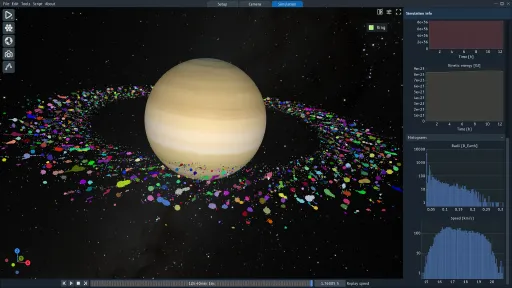
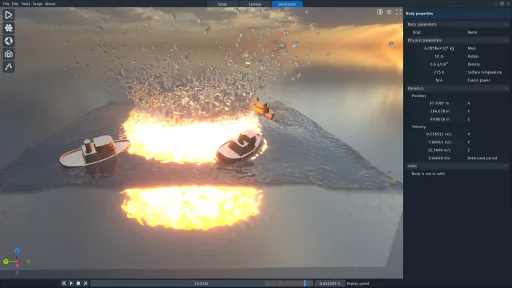
You can recreate some of the well-known simulations from the scientific literature, such as the Moon-forming impact, the formation of the ring system of Saturn, or the DART kinetic impactor. Or you can simply explore various initial conditions, both grounded and realistic, but also hypothetical "what-if" scenarios, such as the collision of two planets made of matter and anti-matter.
Fluid dynamics and gravitation
Each deformable object in the simulation is discretized into particles that interact with each other through collisions (by solving the Navier-Stokes equations) and gravitational attraction. Objects can also be rigid (non-deformable) - they retain their shape, which simplifies collisions between objects and optimizes simulation speed.
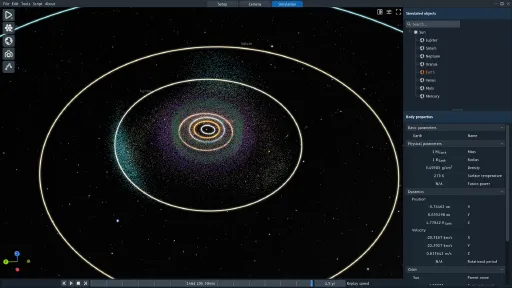
The particle-based solver is useful for simulating a number of astrophysical events, such as the formation of planets from protoplanetary disks or the mutual interaction of galaxies.
Object customization
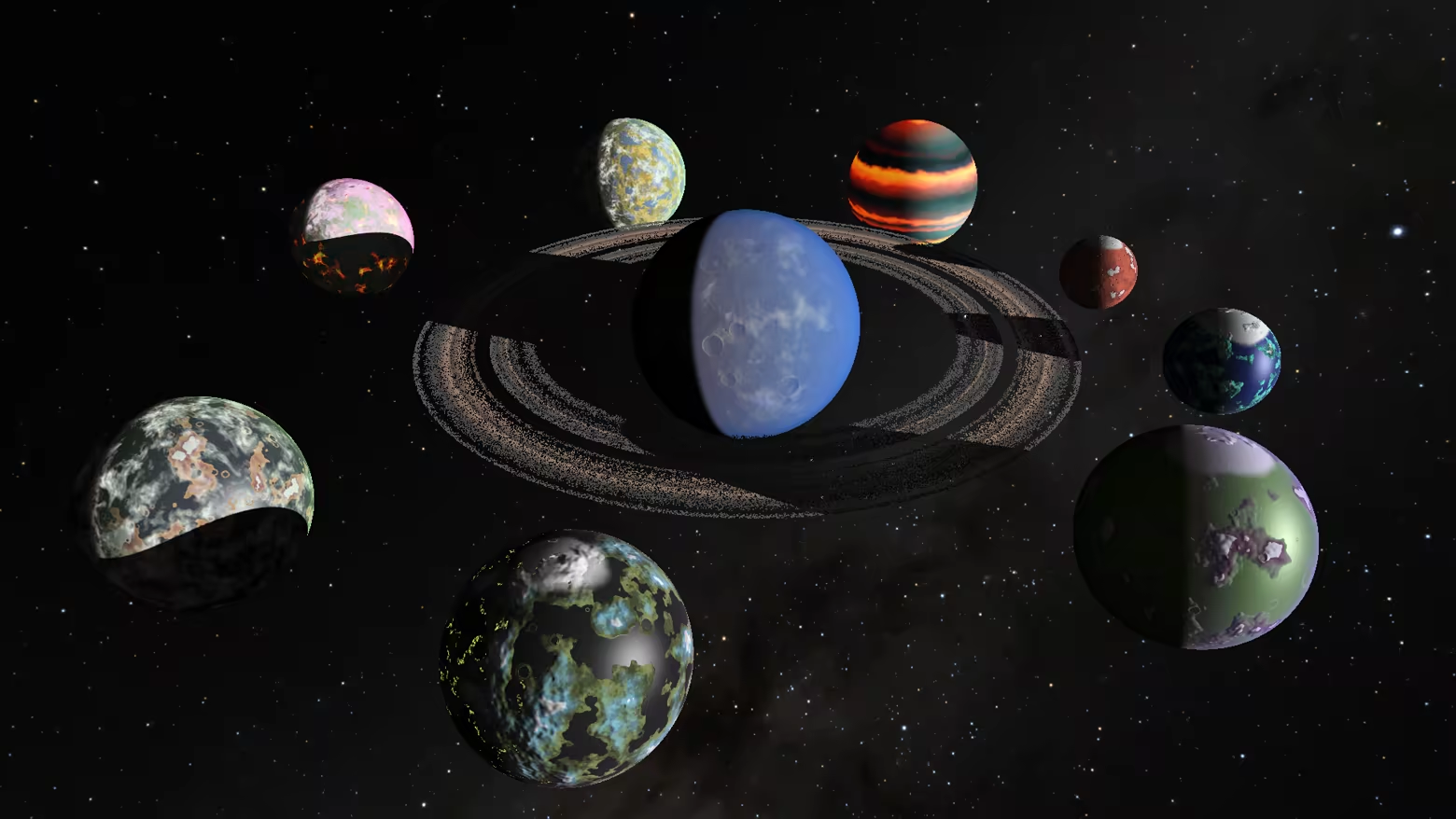
The application has a number of object types - planets, stars, asteroids, disks, clouds, galaxies, and more. Each object has adjustable parameters that allow you to change its geometry, materials, appearance, and simulation behavior. The surface textures of planets and asteroids can be further tailored using procedural generation or by uploading custom images.
Or, if you need even more control, create your own objects using the Lua scripting language.
Black holes (and white holes)
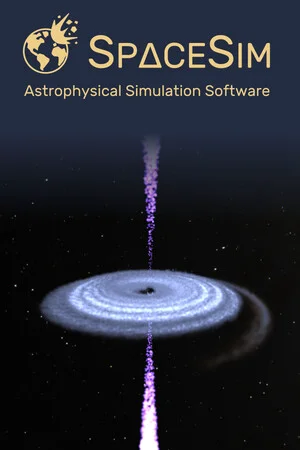
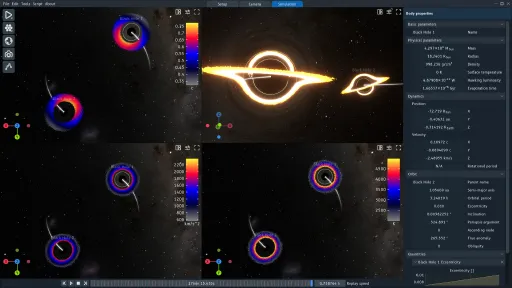
The renderer includes the effect of gravitational lensing, bending the light rays that pass close to a black hole and creating realistic renderings of warped accretion disks, duplicated images of objects behind black holes (including other black holes) or Einstein rings of galaxies.
Particle colors and gravity visualization
SpaceSim provides additional insights into the simulation in a number of ways. It can color particles based on values of a specific quantity (velocity, pressure, material, ...), show the Roche limit indicating where satellites can have stable orbits, or draw the potential field to see the gravity wells around celestial bodies.
Key features:
CPU and GPU simulation solver
Optimized gravity simulation using the Barnes-Hut algorithm
Simulation history - store the entire simulation and replay it later
Two render engines - Real-time or Raymarcher
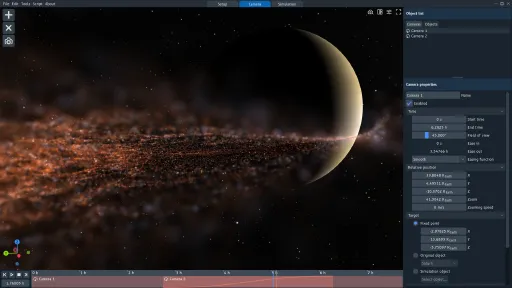
Customizable camera paths with object tracking
Lua scripting for custom objects and simulation systems
Built-in video recording (H.264 codec) and various export options (Alembic, OpenVDB)
Screenshots
6 images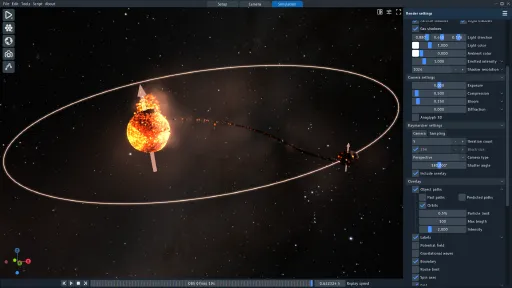
Version Information
Steam Patch Notes
Official update history
A hotfix containing several important fixes:
Fixed continuing simulation from a save file containing the simulation state.
Reduced the number of allocated textures, improving the overall VRAM usage of the application.
Fixed a crash when trying to follow an empty camera path.
Fixed serialization/deserialization of a simulation state containing stress matrices (when shear strength is enabled).
Fixed crashes when re-adding planetary layers.
Fixed certain simulations with small objects (asteroids) stopping with an error message.
Thank you to everyone who reported issues. If you find more bugs or regressions, please let me know.
Added an alternative texturing option to particles (assigning a single color to each particle instead of smoothly mapping the texture to the surface).
Added velocity multiplier to the ring object.
Rings can now be properly added using Lua scripts. To set the parent object, assign the name of the object to the field parent.
Fixed black holes created during simulation having color and atmosphere when using the real-time renderer.
Fixed a crash caused by tracking a disabled object.
Fixed the units of fusion power (color mode).
Fixed issues with loading .gltf files without textures.
Fixed rare crashes caused by auto-exposure.
Fixed particles rendered using color modes not respecting the clip state during the simulation in some cases.
Fixed inconsistent intensities of emitted light.
Fixed planar texture mapping being horizontally flipped for non-deformable objects.
Fixed changes of camera field of view during recording
Fixed parameter updates of Lua objects and Lua simulation systems
Fixed saving supernova colors and opacities to history when using the 'full' history mode.
Current Release
Build 24847399
Uploaded Oct 11, 2026
System Requirements
How to Install
SpaceSim.exe to play
Troubleshooting tips
• Run Redist/_CommonRedist installers if game won't start
• Add folder to Windows Defender exclusions
• Run as administrator
Download
Direct link available
Needed when extracting (WinRAR / 7-Zip) — not a site login.
F566CDC3
4c984fcfc4bc267b24b2416ce2a7a1f3b2f55df3cb16e72a9b3661219d499bee
You May Also Like
View All





Download SpaceSim - Astrophysical Simulation Software for PC with a direct link or via torrent. Get the full version of SpaceSim - Astrophysical Simulation Software for free. SpaceSim - Astrophysical Simulation Software is a Simulation released by Pavel Ševeček.