






About the Game
A real model, not a game-shaped imitation
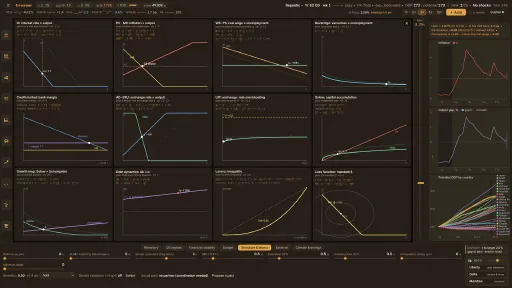
Governor runs your economy on the Carlin–Soskice three-equation model — the one macroeconomics is taught from in upper-year university courses.
IS — Demand. The dearer money is, the less a country spends and invests — but with a lag. Add to that the exchange rate, the government's budget, and how freely banks are allowed to lend.
PC — Inflation and unemployment. An overheated economy pushes prices up faster than a slump pulls them back down. And down is the hard direction: wages are almost never cut.
MR — The monetary policy rule. The game derives the best rate not from a curve, but from what costs you more — missing the inflation target, or unemployment you didn't have to have.
You set the nominal rate. The real price of money is what's left once expected inflation is taken out — and what people and markets expect depends on how far they trust you. Hit the target and credibility accumulates; miss it several quarters running and it crumbles, and the very same rate starts working noticeably weaker. The rate has a floor. If the central bank answers to the government, inflation drifts upward on its own: markets price in the abuse before it happens. Unemployment is tied to output, and banks add their own markup on top of your rate — borrowers pay more than you announced.
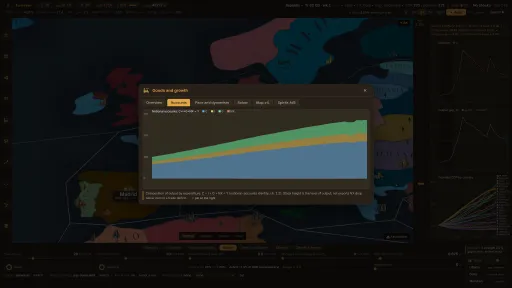
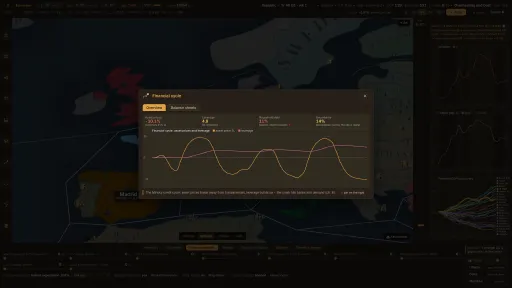
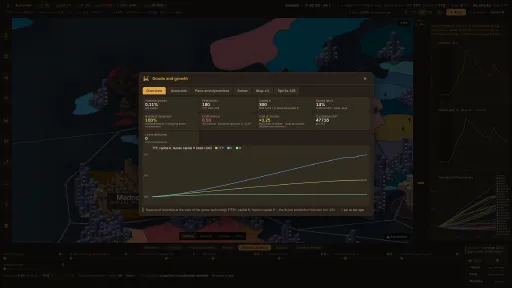
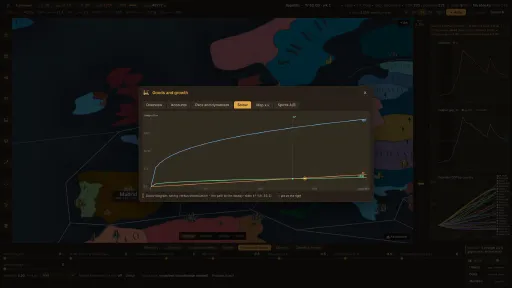
Out of your decisions a long-run picture assembles itself: economic growth (Solow), equilibrium unemployment, inequality (Gini), public debt, the exchange rate and the trade balance — and financial bubbles that inflate and burst if nobody is watching them.
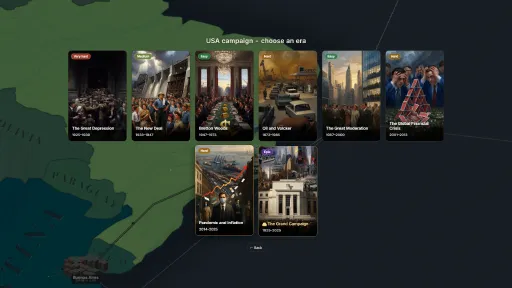
The United States, 1925 to 2025
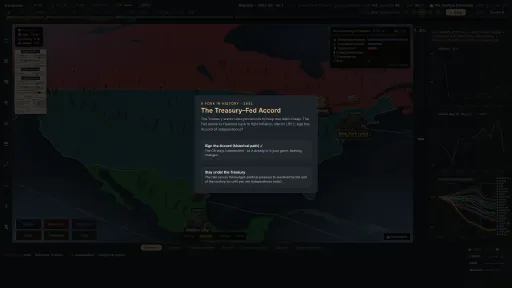
1931, the golden fetters — hold the gold standard, or let the currency go so the economy can breathe.
1971, Camp David — close the gold window, or defend Bretton Woods with reserves.
1979, Volcker — crush inflation with the rate, or take the road of price controls.
2008, the Lehman weekend — put a shoulder under the banking system, or let it fall.
2021, "is inflation transitory?" — wait the price spike out, or hit it early.
The 1929 crash, three waves of bank panics, a war in which the Fed holds rates wherever the Treasury needs them, Bretton Woods, the OPEC embargo, the Volcker disinflation, Black Monday, the Asian crisis, the dot-com bust, 2008, the pandemic and the inflation of 2021–2022 — all of it arrives on schedule. Only one question stays open: what will you do about it?
A full tutorial and a short one, to get the basic economic concepts and the links between them.
An economy you can look at
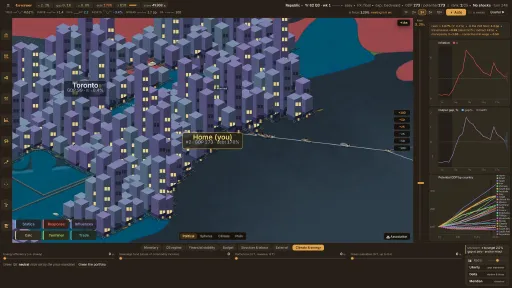
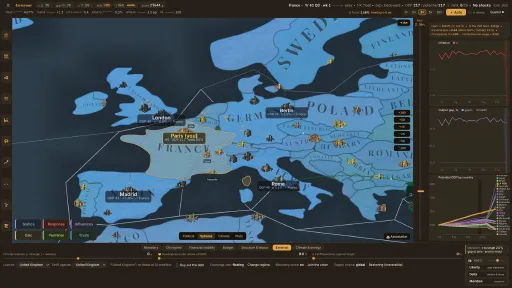
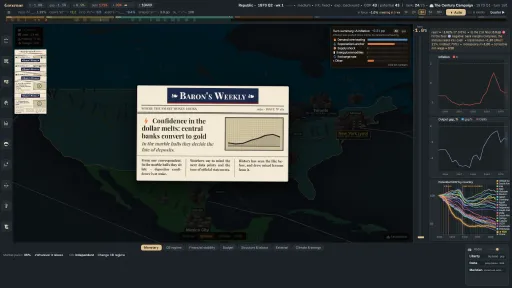
The state of the economy is drawn as a city on the world map. Buildings rise and multiply as the country grows richer; traffic in the streets shows how hard the economy is running; the city's colours warm up in an overheat and go cold in a slump; cranes work when money is cheap and the future looks good. You will see a crisis in the skyline before you open a chart.
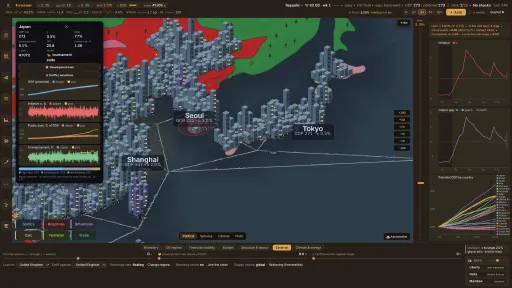
Around it — a world map with historical borders by era and up to 24 rival countries, each with a central bank of its own. They trade with you the more willingly the closer and richer you are; tariffs and trade wars tear those ties apart. A separate mode, off by default, switches on spheres of influence: blocs, satellites, and debt dependency between countries.
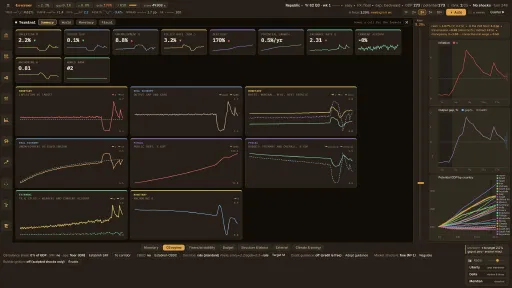
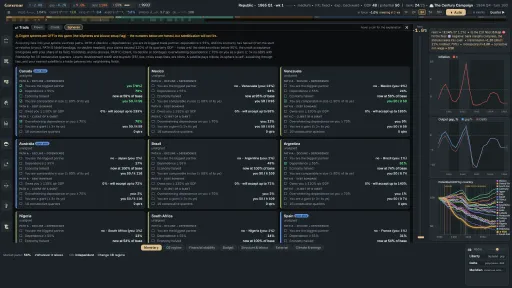
If you would rather have numbers than pictures, there is the terminal: tables, charts, and a breakdown of every move in inflation — by cause, with figures. Plus the influence map: 106 variables of the model and 276 links between them, all on one screen.
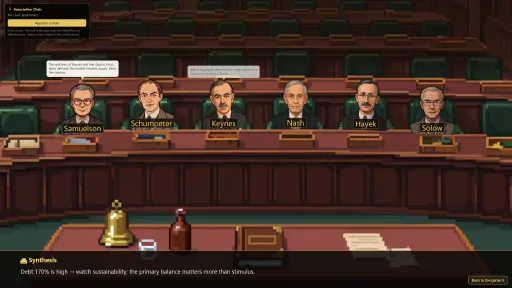
The Association
Gather famous economists into an association of your own.
Once a year the Economic Association meets and takes your policy apart. You appoint the Chair — and with them a school of thought: it grants your economy one permanent bonus and one permanent penalty.
Multiplayer
From two players — over Steam or a local network. Each has their own country and a full copy of the model; after every turn the worlds are reconciled, so your surplus is somebody else's deficit. Credit to a neighbour is a lever too, and debtors know it.
What isn't here
No toy models, no random numbers standing in for an economy, no "correct" playthrough, and no story that will pull you out of a stagflation you arranged yourself. There is a model, a hundred years of history, and the price of a mistake you set for yourself.
Screenshots
17 images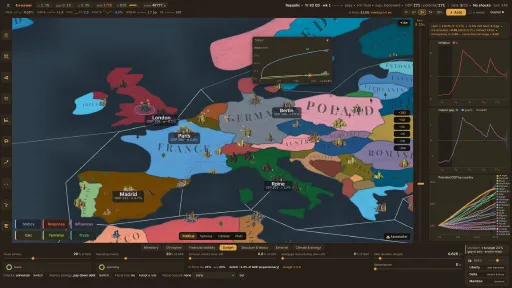
Version Information
Steam Patch Notes
Official update history
The map reworked
- A new look: a deep single-tone ocean with a light depth tint, a muted atlas palette, grey shaded relief showing through the country fills, thin dark borders without light halos. At strong zoom the rasters fade out and the map becomes flat and clean.
- Coasts and borders are now detailed: the Balearics, Corsica, Crete, the Danish isles, Hawaii, fjords and bays are on the map. The Volga no longer breaks at its reservoirs. Trees are gone from the Political and Spheres modes.
- Map tilt: zooming in lays the map into perspective, as in the big strategy games; country names lie on the ground, cities, trains and ships stand upright and shrink toward the horizon; the world view stays flat. Can be turned off in the map settings; turns itself off on machines without graphics acceleration.
- Smooth zoom: the whole world is drawn into an atlas while the game is being prepared, so the map is not rebuilt while you scroll. Country names no longer jump into a corner.
- Switching between the Political, Economy and Population modes no longer stutters: each mode's layer is kept and comes back without a rebuild, and the OWID data is loaded in advance.
- Satellite towns around large cities; stadiums and domes no longer stand in the water. Short rail links across a river or an estuary (New York - Philadelphia) go by bridge instead of a detour to the side.
Explainability
- A "Why?" button above "Association" opens the chain of causes: inflation → channels → overheating → output gap → its channels → the turn's values (the rate against the rule, the lending rate and spread, the budget in force, asset prices, the exchange rate) → the lever and the tab it lives on. The demand composition, consumption included, is there too.
- A panel opens as a column next to the rail, below the indicators, instead of full screen: the indicators, the map and pinned windows stay visible, so two charts can be compared.
- Pinned windows resize by the corner and snap to the edges and to each other.
- Statics: numbers on the axes; hovering any line (including the faint "initial" one and the dashed reference) or an axis symbol tells what it is.
- Tooltips on yield, curve slope, FX q, assets and spread in the markets bar; explanations for PAYG, bequests, the capital levy, capital transparency and the fiscal council.
Model and scenarios
- New teaching scenario "Policy error (Bank of Russia, 2026)": inflation 6 % against a 4 % target, played as Russia, seven years; the four scenarios of the Bank of Russia analytical note can be played by hand, and the hint under the rate keeps the cumulative output loss against the rule path.
- New setup flag "Hyperadaptive expectations": the speed at which expectations adjust rises with the inflation miss, plus the exact Fisher relation at double-digit inflation.
- The "GaR" indicator on the gap chart and in Equations is renamed "gap lower bound": it is a stress estimate of the current gap, not growth-at-risk in the academic sense.
- Multiplayer works: turn-based, one quarter per turn.
Fixes
- When zooming the map, ships sometimes turned into cars and cars on land into ships.
- The Lorenz curve at low inequality bulged - the middle steeper than the top; now the per-capita share always rises from bottom to top. Axis ticks 0.25/0.75 are no longer rounded to 0.3/0.8.
- The tax and spending "in effect" are now saved: after loading they are no longer set equal to the sliders.
- The answer field on a study card, if a click gives it no caret, brings keyboard focus back to the window itself.
- The Productivity and Capital K cards used to reset to 100 after loading a save; the index base is now the start of the game.
- The Treasury labels update after the turn, the countdown to the next reform ticks down, and the pension-reform button is available again once the cooldown is over - no reload of the save needed.
Map
- Large countries are split into macro-regions along statistical divisions: nine US census divisions, eight Russian federal districts, fifteen Chinese regions, Europe's NUTS-1 and so on - 61 countries, 273 regions. A region is drawn by its borders, labelled at strong zoom and opens the country dossier on click.
- Two new map modes, Economy and Population: output density and population density for the game year (Our World in Data), regions inside a country by their share. The mode bar moved to the bottom right, now icons, with a legend.
- Relief twice as detailed, a coast rim and a border ribbon: land reads as raised above the water and borders no longer sink between two bright fills. Inland seas and large lakes (IJsselmeer, Vättern, Balkhash) are water now.
- The country dossier has a Regions block: share of output, output, shift versus the table, density and the gap between the richest and the poorest region. The dossier is wider, four columns of figures.
Model
- Romer and Piketty mechanics are in the base model: a hybrid Phillips curve, Brainard caution, investment inertia, saturating forward guidance, Cagan seigniorage with a ceiling, top 10 % and 1 % shares with an r − g attractor, tax structure, wealth tax and capital levy, an investment tax credit, a fiscal reaction rule.
- Third wave: a demographic transition by era, the social state as the era baseline, entitlements and a pension system, public capital, real wage rigidity, a rollover auction for public debt. The century campaign is recalibrated: the US debt curve by decade is closer to the record than ever.
- Games started on earlier versions keep playing by their own rules - nothing switches mid-game.
Advisor and interface
- "Advisor drives" checkbox: the autopilot sets the MR-rule rate, light growth levers and a smooth consolidation under a debt overhang. You can take the levers between turns - handy for first games.
- The Response button is now Forecast: the central-bank fan chart first, the impulse response second. Long fiscal levers moved to a new Treasury tab, so Budget no longer scrolls.
- Your own setup templates: save a set of options under a name and apply it in later games.
- Cleanup: chips without outlines, a zero without a dot in the indicators, a smooth entry into a game, the regime-change bar no longer squeezes the map, newspapers no longer dim the desk on routine spread shocks, Chinese dock tabs without scrolling.
Cities on the map
Built-up areas are redrawn from scratch in true isometry and along national schools of urbanism.
- The unit is a parcel, not a cell: microdistricts of slabs and courtyards in the Eastern bloc, perimeter blocks with a courtyard well in Europe, a podium with a corner tower in East Asia, a medina in the Middle East, a Spanish grid with a plaza and a church in Latin America, malls on the outskirts of North America.
- A building reads by its mass: roof form (gabled, hipped tile, flat with a parapet, ledge), domes and landmark silhouettes - pagoda, minaret, shikhara, church tower. Small things are gone on purpose: windows, chimneys, antennas and tanks were dirt at close range.
- Flat roofs now sit inside the walls instead of overhanging as a wider slab. The tower stands on its podium instead of piercing it. Roads are one tone, cranes have volume.
- Cities no longer "build up and sink": three different defects behind one symptom were found frame by frame and fixed. Young China at long range is no longer black diamonds.
A cold war in the campaign chapters
All seven chapters switch on spheres, ties, the world financial cycle and cross-border capital by themselves.
- From 1947 to 1991 the world is split by the curtain - the map hatches the blocs and draws the curtain line, the journal says when it falls and lifts. Trade across the curtain costs like a tariff; unions form only inside your bloc.
- Financial contagion travels by bloc: a bust on the other side of the curtain reaches you four times weaker, and swap lines do not cross it. A global crisis stays global.
- Capital as a flow: every country holds a stock of inward foreign investment that comes from large economies to where returns are higher and risk lower - on its own side of the curtain and toward friends, never through sanctions. Switching sides or sanctions mean capital flight.
- Decisions about sides: the Marshall Plan (1947), a client asks for help (1961, 1982), détente (1972), the East opens (1990). Bot hegemons decide the same by rule: the USSR runs its own Molotov Plan, bloc clients in trouble get grants, a slump pushes a hegemon toward détente.
A world on the calendar
- Choosing a real country and year (Our World in Data) within 1925–2024 now moves the world too: eras advance by year, the horizon runs to 2025, country sizes are those of the year, and the world events of the century arrive - Kreditanstalt, the oil shocks, the ICT waves, Lehman, the pandemic. Sweden-1930 gets Kreditanstalt on turn seven.
- American policy of the century (NIRA, Wagner, price controls) does not travel into someone else's game.
Learning and game setup
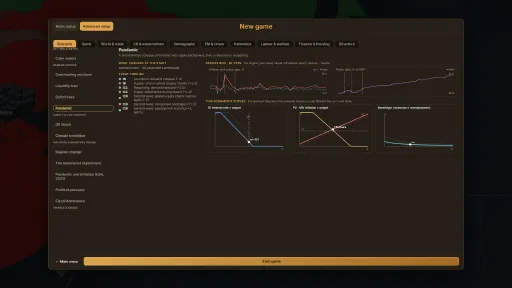
- The sandbox is a card screen of scenarios with their curves by group, then a scenario screen with templates and fine-tuning tabs; the classic screen remains in full.
- The task ladder: "Next" follows the textbook, missions grew out of scenarios, tasks carry curve pictures, the mission coach highlights the levers. The ZLB mission starts at the rate floor.
- The "Demand shock" mission judges what it promises: inflation at target, not a GDP threshold. Before, the player brought inflation to target and read "not passed".
- Tooltip cards open on the levers in the bottom tabs too, not only on the indicators at the top, and wait for the cursor to pause instead of popping on touch.
- UI scale 80–150%, country choice beats the roulette, a post-mortem at the end of a run, practice in five lessons, emoji removed from the interface.
Saves from earlier builds keep playing by the rules they started under.
Multiplayer
The main fix of this update. In the previous build a network match started with the interface hidden: full-screen map, your own country labelled — and no top bar, no dock, no rate lever, so there was physically no way to submit a turn. The turn button existed, with zero width.
- The cause: the mechanism that restores the in-game layout was written, wired up, and never called. The same trap had already been fixed for "Continue" and for loading a slot; the network path was missed then.
- Separately: network games ran on the old investment calibration while single-player used the new one. Capital-to-output diverged threefold.
- A refused join now names the reason instead of leaving you at "waiting for host" forever.
Only identical builds can play together. Peers with different engines are refused at the door — that is a safeguard, not a fault: otherwise the worlds would drift apart silently and the match would break around turn thirty.
The campaign is now a chain of terms
The seven chapters are one state across a century, not seven independent games.
- What passes on is the deviation from your successor's era benchmark, not a raw number: anchor credibility, debt, potential, inequality. A raw handover would have given Volcker-1973 a debt of 426% of GDP instead of the historical 35%.
- Anchor credibility carries by the conduct of your term, not by its final number: two chapters end exactly on the credibility floor, where no number can tell a good governor from a bad one.
- New Legacy screen: what you built over your term, what you inherited, and what passes on. It honestly shows what did not carry and why — the successor's era does not know of it yet, the value sat on a model boundary, or the benchmark itself is on one.
- The head start is finite: the era eats an inherited anchor in 18–38 quarters. A bad term costs your successor up to 2.7x the pain; a good one helps only a little — an inheritance hurts more than it helps.
Institution tree
Previously an instrument simply did not appear until its year of invention, so "not invented yet" and "not in this game at all" looked the same.
- A new screen covering all 20 institutions: founded · available now · waiting on another decision · opens in a given year · lost for good.
- "Lost for good" has two distinct causes and they are not conflated: the year of invention lies past the end of the chapter, or the term is already over.
- Every row says whether what you found will reach your successor. Four institutions can be founded but never handed on — the chain of terms ends with their chapter, and the row says so.
Shocks announce themselves — most of them
Previously every scenario adjustment landed whole in a single quarter. There was nothing to answer it with: the policy rate acts with a lag, so in the quarter of impact the player has no instrument at all. Measured: raising the response from 3 to 3.5 pp improved the worst output gap by 0.004 pp, while a four-quarter ramp improved it by 2.73 pp.
- 66 events across 27 chapters now arrive over several quarters, with the same total size.
- The forecast says what is coming, when, how large and for how long.
- 47 events stay sudden by design. Black October, Lehman and 15 August 1971 are not announced six months ahead.
Reading the model
- Hovering any indicator opens a card: definition, formula, a mini-chart and links to related concepts. 37 concepts had been written and translated into three languages — and were shown nowhere.
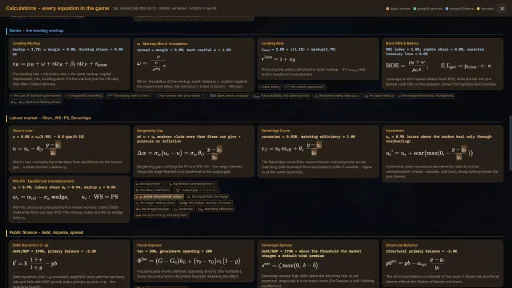
- Every panel chart now carries its equation, with clickable terms.
- Six formulas disagreed with the engine and have been corrected. Among them the central bank loss function (the weight was labelled "output" where it applies to inflation) and the debt law, which still stood in a form the engine had abandoned a year earlier.
Learning and countries
- Lessons and missions are now one chapter-ordered ladder instead of two separate sets.
- Countries have a structural profile — nine archetypes, not merely different first-turn numbers.
- The choice of diffusion doctrine is no longer inert in most chapters.
Interface
- Full-screen panel, wooden desk surface.
- Fixed the text colour on brass: the variable referred to itself, and twenty rules were painting the active tab in the inactive colour.
- "Back" from the setup screen returns to the previous screen, not to the main menu.
Saves from earlier builds keep playing by the rules they started under.
The curves now match the model
The main fix of this update. The Phillips curve was drawn as a STRAIGHT LINE, while the engine bends it on both sides — and both nonlinearities are active in an ordinary game, not in some special mode:
- upward — the convexity of tight capacity: 4 pp of overheating DOUBLES the slope;
- downward — downward wage rigidity (DNWR): inflation does not fall linearly but is squeezed asymptotically, because nominal wages do not go down.
Measured slope across the range: 1.50 at +4 pp of overheating against 0.14 in deep deflation — a tenfold difference. A straight line with a constant slope was lying in exactly the places you look at a Phillips curve for.
It turned out this picture existed twice in the game: the main-screen diagram and the "Statics" cells (also used for scenario previews and the map overlay) were computed from separately written formulas. Both now share one source, and any drift from the engine is caught by a test.
An audit of all twelve textbook diagrams
Since one picture lied, we checked every one. Five disagreed with the model:
- The Beveridge curve — its own formula instead of the engine's matching function. At the rest point it showed 0.68% vacancies where the engine gives 2.79% — four times off.
- The Lorenz curve — a smooth arc instead of the three-tier polyline. The Gini coefficient matched, but the hollowing of the middle — the very thing the decomposition exists for — was invisible.
- Debt dynamics Δb × b — a straight line instead of a kinked one. It hid the main point: past the sovereign-premium threshold the interest rate rises TOGETHER with debt, and a second equilibrium appears — the one past which debt cannot be brought back. The threshold is now drawn and both points marked.
- Solow and the growth map — capital depreciation was left over from an old calibration and showed a steady-state capital stock half the engine's.
The formulas printed under the diagrams were rewritten too: they contradicted their own pictures.
Saving finished games
From a player report. A finished game could not be saved — and this turned out to be four bugs, not one:
- the results screen had no save button;
- Esc did not open the pause menu once the game had ended, and the pause menu is the only door to the save slots;
- switching language or window mode did not autosave a finished game: a completed century was lost silently;
- and if you did get such a save, it opened onto a frozen board with no explanation.
The button now sits on the results screen, pause works after the game ends, the autosave fires before a reload, and a loaded finished game opens with its results screen.
UI scaling
Requested on the forum: everything was too small on 4K. Ctrl + and Ctrl − change the scale on the fly, Ctrl 0 returns to 100%, and the same control is in the settings. Everything scales together — fonts, the map, charts and diagrams — because this is zoom, not font size.
The PC·MR diagram on the main screen
The third overview chart at the bottom right now shows PC·MR: your economy as a POINT on gap × inflation axes, with a trail of where it came from. The small "▼" in the corner switches the window to IS, WS-PS, the debt phase diagram, or the old country ranking — which has not gone anywhere.
The brief tutorial
Reworked so that the player makes real decisions:
- the game starts with inflation above target, so raising the rate is now NECESSARY rather than "press this because we asked". Previously the lesson started in equilibrium, and the player's very first action damaged a healthy economy;
- a second exercise was added: cut the rate so the dot lands on the MR line instead of punching through it;
- and it explains what all of it is for: you aim at MR, but you cannot land there in one quarter — the rate works with a lag, so the job is to shrink the distance to the line turn after turn.
Spheres of influence
From a player report: a small country was vassalizing a large one. Debt bondage did not check sizes at all, and its threshold was tied to quarterly GDP. The threshold now depends on the size ratio and is expressed in annual GDP: bonding an economy larger than yours is still possible, but it has become an event rather than a routine. Measured over three centuries: cases of "creditor smaller than victim" went from 1 to 0.
"Statics"
Labels on the diagrams no longer collide — they are placed by a layout pass that knows what has already been drawn. Curves leaving the frame now break off instead of running along the edge: that used to read as "the model flattens out here" while meaning the exact opposite.
Demo
- task cards removed;
- the starting country can only be one of the four the demo actually simulates — previously you could pick a country that does not exist in the game world.
Smaller things
- the formulas in the detailed tutorial are typeset the same way as in "Calculations";
- each campaign chapter now has its own grading bar instead of a shared era-wide one;
- achievements are awarded only with task cards enabled ("Medium" or higher).
Current Release
Build 25296246
Uploaded Sep 15, 2026
Requests are paused right now
Requests are paused while we work through the current backlog of ~200 open requests. Voting on existing requests still works — check back soon.
Login Required
You need to be logged in to request game updates. Would you like to go to the login page?
Request Update
Request an update for Governor? This will notify uploaders that this game has an available update.
Request Submitted
Your update request has been submitted successfully! Uploaders will be notified.
Request Failed
Failed to submit update request:
System Requirements
How to Install
Governor.exe to play
Troubleshooting tips
• Run Redist/_CommonRedist installers if game won't start
• Add folder to Windows Defender exclusions
• Run as administrator
Download
Direct link available
Needed when extracting (WinRAR / 7-Zip) — not a site login.
You May Also Like
View All








Download Governor for PC with a direct link or via torrent. Get the full version of Governor for free. Governor is a Indie released by Daniling.