







About the Game
Every price is discovered, not scripted.
Most trading games decide what a stock is "worth," nudge the price toward it, and paint a chart on top. It looks like a market. It isn't one. You're watching a slideshow with a buy button.
MarginCall fakes nothing. Every tick is a real trade, matched on a real order book between buyers and sellers who each decided, on their own, what a company is worth. No hidden fair value, no script. Just supply, demand, and consequence, the same forces that move real markets.
Simulated all the way down.
A price only changes when two orders match. Every bid is backed by real cash, every offer by real shares. Every trader independently values companies on imperfect information. A living economy sits underneath and drives what companies earn. Crashes, bubbles and bankruptcies aren't scheduled; the market makes them happen, and every move traces back to the exact trade that caused it.
A market that plays fair.
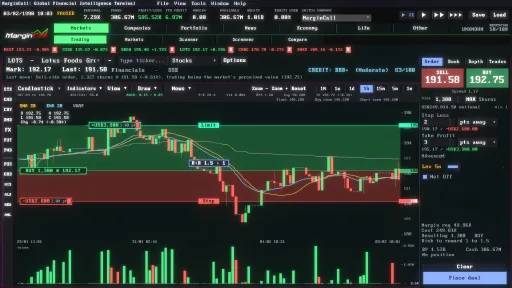
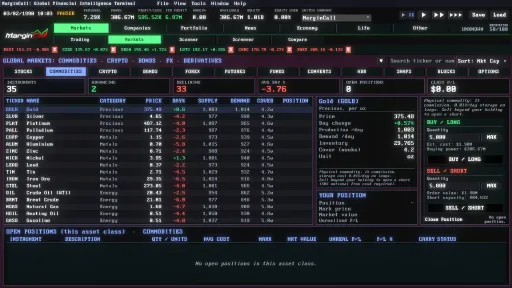
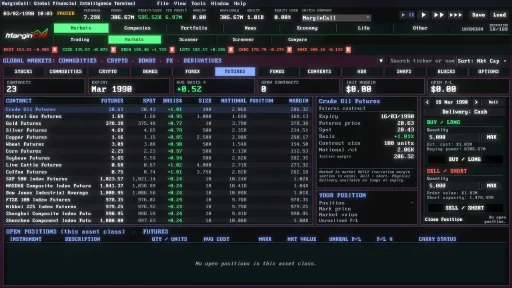
At the core is a genuine central limit order book, the machinery real exchanges run on: real spread, real slippage, real depth that thins when everyone heads for the exit. Trade like a professional with market, limit, stop-loss and trailing-stop orders. Go long, go short, hedge, use leverage, then respect it, because the margin monitor never stops watching, and the moment your equity falls through the line it force-liquidates you. No difficulty slider. The market rewards what you learn and charges you for what you don't.
Every trader has a mind of its own.
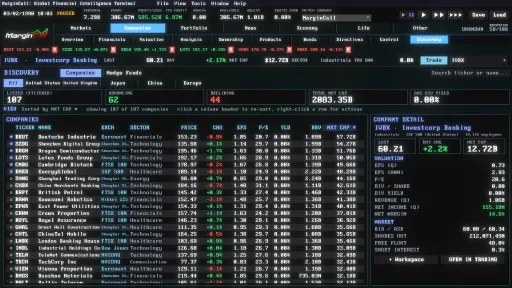
Hundreds of participants disagree for real reasons. Market-makers quote liquidity, momentum funds chase trends, value desks buy cheap and short absurd, bubble-chasers pay 200x earnings for a story. Each trades on its own imperfect information, skill and bias, which is why real markets misprice, trend, bubble and break. Hedge funds blow themselves up when they overreach, and you can buy them out.
An economy that feeds the market.
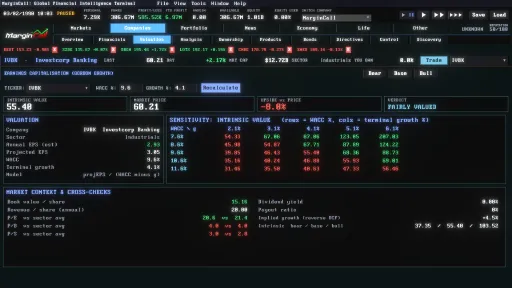
Underneath runs a living economy: industry, commodities, labour and consumer spending across five blocs, each with its own rates, inflation, unemployment and GDP cycle. It feeds what companies earn, earnings feed a real DCF valuation, and valuation shapes what traders will pay. Pull one thread and the whole tapestry moves.
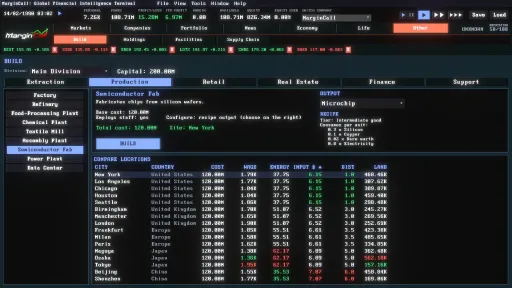
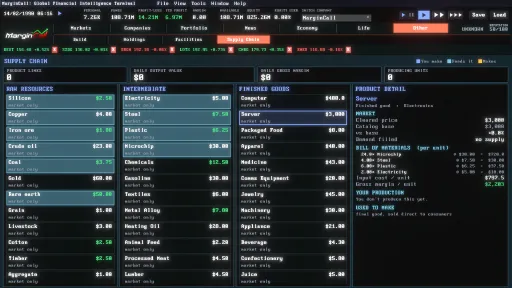
Every finished good traces back through a real bill of materials, from raw resources to the product on the shelf. Mine silicon, refine it into microchips, build those into computers, and sell into a market that actually pays for them. Own a factory at every tier and you capture every margin along the way, or build a data center and sell hosting services, or mine cryptocurrencies instead. A built in visualiser maps the whole graph and rolls up your output and margins across every line you run.
Become the Market Leader.
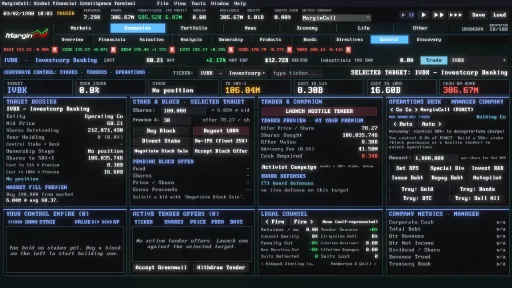
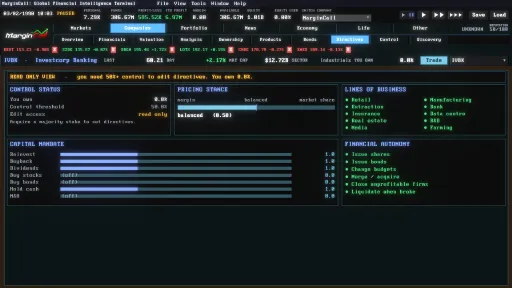
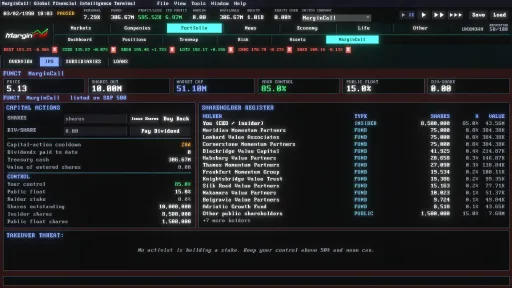
Accumulate a position and climb from Observer to Consolidated until you own a company outright. Launch IPOs, trigger mergers, force buyouts, take your own company public, then defend it, because a big enough rival stake can oust you as CEO. Act on an insider tip if you dare, but the regulator is modeled too: investigations, fines and bans are real.
A life, not just a game.
Age, health and time matter. Take loans, buy property, pay taxes. Compound a fortune across decades and retire a titan, or push too hard and lose it all. The universe runs off one deterministic clock, so skill is skill, not luck.
The market plays fair. Prove you can beat it.
Screenshots
28 images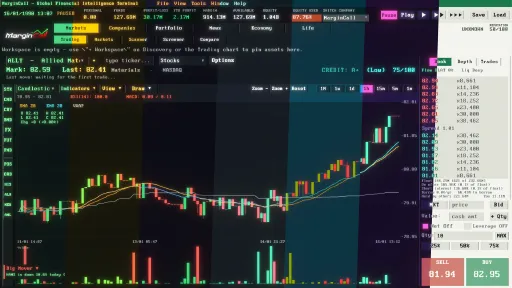
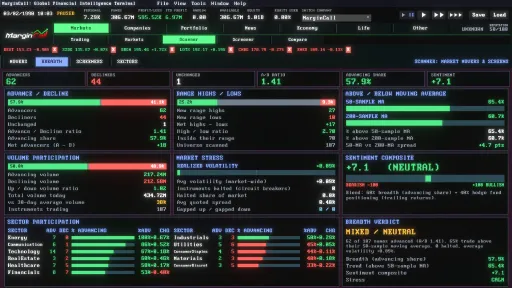
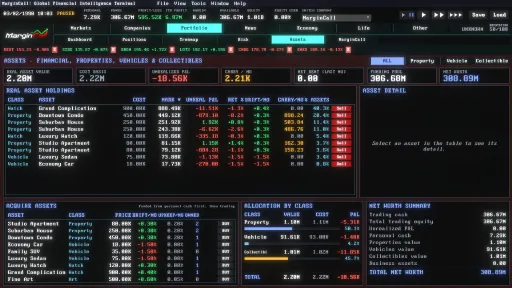
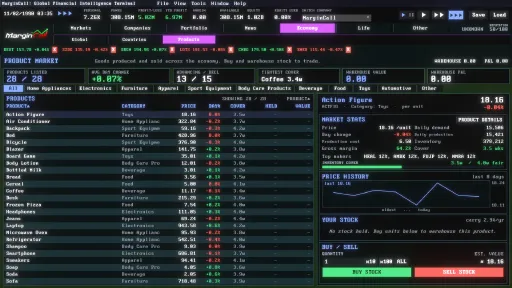
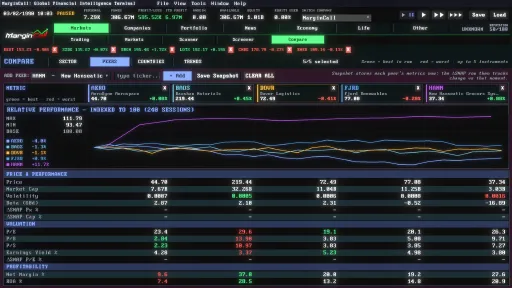
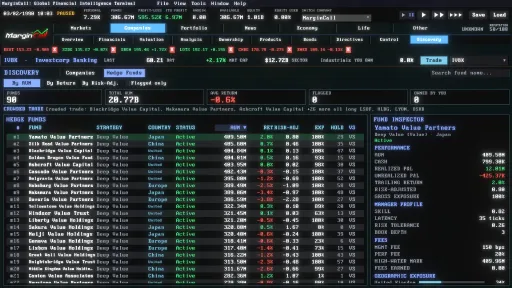
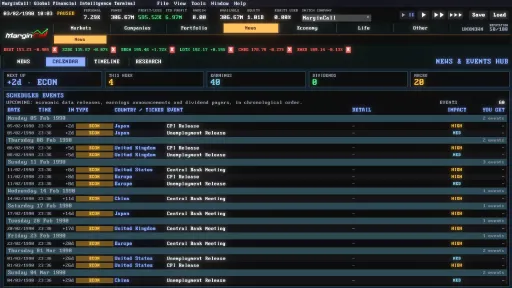
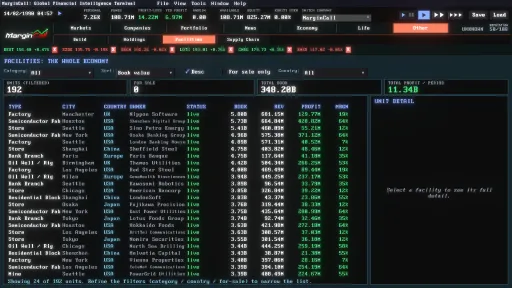
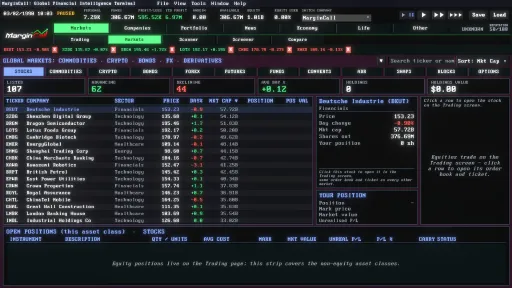
Version Information
Steam Patch Notes
Official update history
Hi everyone,
Following yesterday's major Beta Branch update, we've released a smaller follow-up patch focused on issues and edge cases that became apparent after the new economic systems were put through wider testing.
The main focus of this patch is economic and market stability. We've addressed an issue that could cause widespread declines across companies and major indices, along with several underlying problems involving facility profitability, company earnings, insolvency and financial statements that could compound over longer simulations.
We've also made further improvements to bankruptcy behaviour, facility economics, accounting, Altman Z Scores, hedge funds and save compatibility. A particular focus has been making sure older saves affected by these issues can recover automatically without altering player cash, debt, ownership or equity balances.
Thank you again to everyone testing the Beta Branch and reporting issues. The longer-running saves and detailed reports have been especially useful for identifying problems that aren't always visible during shorter testing sessions.
Here's what's changed:
Economy and Market Stability
Fixed a global market decline that could cause most companies and major indices to collapse over time
Fixed synchronized company price crashes caused by unstable production and earnings calculations
Improved long term market stability without artificially preventing legitimate recessions, losses, or bankruptcies
Corrected positive economic conditions so they provide an appropriate positive influence on equity markets
Reduced extreme company price movements caused by temporary changes in daily facility performance
Improved earnings smoothing so quarterly results represent sustained business performance
Prevented incomplete facility data from replacing otherwise valid company financial results
Improved index continuity when companies are delisted or their constituent universes change
Fixed historical chart data from a previous game appearing in a newly loaded or freshly started game
Fixed opening market charts incorrectly showing large crashes caused by abandoned timeline data
Companies and Bankruptcy
Fixed the underlying profitability problems that caused widespread company distress and bankruptcy waves
Removed the artificial global bankruptcy limit so genuinely insolvent companies can still fail independently
Improved insolvency checks so temporary losses do not automatically destroy otherwise viable companies
Fixed insolvency checks stopping after loading an earlier save
Improved liquidity support for companies experiencing temporary but recoverable losses
Fixed dormant companies repeatedly renewing assets despite having no operating activity
Added gradual asset run off for genuinely dormant businesses
Improved bankruptcy handling for company shareholders, bonds, facilities, and financial records
Improved company formation and replacement so the listed market does not permanently shrink after failures
Facilities and Business Operations
Fixed aggregate company facilities with billions in book value generating only thousands in daily revenue
Removed an incorrect production limit that treated large regional business estates as only four ordinary facilities
Recalibrated facility capacity so production, revenue, and asset values operate at compatible financial scales
Fixed facility operating expenses so upkeep scales with the actual cost of the assets employed
Improved revenue and cost accounting for factories, mines, oil wells, power plants, stores, property, and financial facilities
Fixed extreme facility margins reaching hundreds or thousands of percent because revenue and costs used different scales
Facility margins now display clearly when revenue is too small to produce a meaningful percentage
Extremely large valid margin values now use compact formatting instead of overlapping nearby columns
Improved commodity cost pass through while retaining bounded and financially plausible results
Fixed gross losses being lost or incorrectly converted into profitable results during financial statement generation
Improved facility mothballing so persistently unprofitable AI facilities remain inactive when appropriate
Fixed established AI companies and newly listed companies missing their required operating facilities
Improved facility level migration so malformed legacy facilities are repaired without changing player owned facilities
Financial Statements and Accounting
Improved company income statements, balance sheets, and cash flow statements so their values reconcile correctly
Fixed facility revenue, cost of goods sold, operating expenses, operating profit, interest, and tax flowing into the wrong statement lines
Fixed operating losses receiving unsupported tax benefits
Fixed tiny residual revenue producing meaningless billion percent profit margins
Improved the distinction between statistical revenue and realized facility sales
Added clearer revenue basis descriptions to company financial statements
Improved accounting continuity across quarterly reports and save loading
Fixed company investment spending being expensed more than once
Added tighter limits to AI investment budgets to prevent runaway spending
Improved debt, equity, retained earnings, and liability calculations used by company analysis screens
Altman Z Score and Credit Analysis
Rebuilt the Altman Z Score using working capital, retained earnings, operating income, total liabilities, sales, and market equity
Fixed companies displaying impossibly large Altman Z Scores
Financial companies now display the Altman Z Score as unavailable because the standard manufacturing formula is not appropriate for banks
Companies with immaterial liabilities no longer use an artificial one dollar denominator
Corrected safe, grey zone, and distress classifications
Added compact Altman Z formatting to prevent text overlap in financial, credit, comparison, and screener tables
Improved quality scores so unavailable Altman values do not incorrectly create distress penalties
Funds and Institutional Markets
Fixed hedge fund returns being distorted by investor deposits and withdrawals
Improved hedge fund risk adjusted return calculations
Added long term limits to external hedge fund asset growth
Fixed failed hedge funds not being replaced correctly
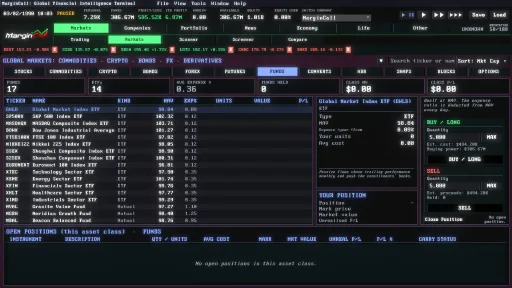
Improved fund and ETF chart history across saving and loading
Fixed fund charts combining prices from different game timelines
Save Compatibility
Added automatic recovery for saves created by affected game versions
Broken legacy facilities are recalibrated immediately when the save loads
Save recovery can repair facility capacity even when the saved company revenue was already damaged
Player built and directly controlled facilities are preserved during legacy save repair
Fixed missing AI operating footprints in older saves
Fixed old chart history contaminating a loaded world
Improved restoration of insolvency schedules, market history, financial data, and company operations
Save recovery does not rewrite player cash, debt, ownership, or equity balances
Interface and Readability
Fixed overlapping values in company comparison and screener tables
Added bounded formatting for unusually large financial ratios
Improved facility margin formatting for extreme or unavailable values
Removed an unnecessary console warning from the assets interface
Improved the readability of company credit and financial analysis panels
Simulation Controls
Improved high speed simulation safeguards to prevent excessive tick backlogs from freezing the game
In addition to the Beta Branch released yesterday, here's some additional changes to help improve the production economy, QoL and some UI issues:
Production Economy
Fixed a supply and demand issue that could cause heavily overproduced goods, such as cocoa, to become more expensive instead of cheaper.
Excess supply now correctly lowers market prices and reduces the amount producers can sell.
Expanding production no longer creates artificial demand to match the additional supply.
Commodity-linked products now respect national demand while continuing to use commodity market pricing.
Production costs now account for materials, extraction, freight, wages, variable upkeep and fixed overhead.
Improved production cost calculations at very low production volumes.
Rebalanced production recipes across supported industries and production methods.
Production speeds have been rebalanced while preserving established company revenue levels.
AI companies now make more informed expansion decisions based on expected utilization, competition, setup costs and projected returns.
AI companies are now more likely to sell or close facilities that are consistently losing money.
Local service demand now takes population, income and competition into account.
New competing facilities are now considered when estimating local service demand.
Service utilization continues to adjust gradually rather than changing instantly.
Operations & Holdings
Added collapsible industry and building category headers.
Added checkboxes for selecting multiple buildings at once.
Added Select All and Deselect All controls.
Added batch configuration for multiple selected buildings.
Mixed selections are now grouped by building type for easier management.
Multiple buildings purchased together are now represented as a single building with the appropriate level.
Buildings can now be upgraded based on current construction costs.
Added building downgrades with a dedicated confirmation window.
The downgrade window includes an amount slider, refund preview and confirmation button.
Downgrading refunds 50% of the current construction cost for each removed level.
Building levels can now be split into separate buildings.
Split buildings retain their proportional book value, construction basis and other accounting values.
Compatible facilities can now be merged together.
Mixed selections can automatically merge compatible buildings by type.
Existing buildings from older saves are automatically treated as Level 1.
Added safeguards to prevent upgrades, downgrades, splits and merges from causing accounting inconsistencies.
Operations Interface
Building selection controls now update smoothly instead of constantly refreshing.
Fixed flashing on bulk action buttons.
Fixed flashing on the Sold to Consumers As control.
Improved the Building Levels window layout and text wrapping.
Replaced the immediate one-level downgrade action with the new downgrade configuration window.
Fixed missing Output and Resource information when first opening the Build tab.
The initially selected building now displays the same complete information as manually selected buildings.
Inventory & Warehousing
Fixed producers failing to deposit goods when their routing was set to Inventory.
Every company now has 30,000 units of baseline staging capacity.
Each Warehouse level adds an additional 30,000 units of storage capacity.
Higher-level Warehouses provide the same total capacity as the equivalent number of individual Warehouses.
Goods exceeding available storage capacity are now automatically sold to the market.
Goods sent to Inventory are stored at their production cost basis.
Updated the Warehouse description to better explain Inventory routing, storage capacity, production costs and automatic overflow sales.
Compatibility & Reliability
Building levels are fully compatible with existing saves.
Existing buildings are safely converted to the new level system without increasing their existing capacity or production output.
Improved reliability across building aggregation, warehouse capacity, inventory handling and downgrade refunds.
Performance
- Fixed a progressive slowdown that set in after roughly nine in-game months, on both fresh and loaded games.
- Fixed an additional, slower slowdown that crept in over one to two in-game years of continuous play.
- Removed the one to two second freeze that could hit at the end of each in-game month on larger save files.
- The monthly autosave now writes in the background, so the game keeps running smoothly instead of pausing to save.
- Greatly reduced the ongoing cost of corporate bond pricing, credit ratings, and net worth updates on long-running games.
- Account margin is now checked once per tick for the whole portfolio instead of being recomputed for every listed company.
- Saving and backup rotation are faster and no longer re-read the entire save file to verify it.
Economy and Balance
- The combined number of AI companies and hedge funds is now capped at 200 so the market no longer balloons to extreme sizes over a long game.
- Games already above that size are left intact and simply stop adding new companies rather than removing any.
Fixes and Polish
- Corporate bonds are now charted per issuer, matching how they are traded and listed everywhere else in the game.
- Market indices no longer count companies that have been taken private.
- Companies taken private no longer generate options volatility updates or insider-trading rumours.
- Fixed the corporate bond details line on the trading chart header, which could appear blank.
- You can now inject your own cash as capital into companies you control (50%+), funding their treasury instead of just buying more shares, and Take Dividend now pays a real dividend from the company's cash.
MONEY AND EXPLOITS
- Fixed a net worth exploit when buying funds using a company you control
- Debt financed fund buyouts are now actually paid for instead of being free
- Fund buyouts now check your free cash so they cannot spend reserved margin
- Injecting capital into a fund you own no longer inflates your net worth
- Special dividends from a fund you own now pay into the correct account
- Depositing to your company on the Life page now moves money from the right account
- Buying out a hedge fund no longer lets outside investor money inflate your net worth
- Liquidating a merged fund now pays out its remaining holdings instead of destroying them
- Corporate bonds can no longer be bought cheap and sold near par for free profit
- Subsidiary operating losses are no longer quietly forgiven when the wallet runs dry
- Warehouse purchases now check free cash so they cannot double spend reserved money
VALUATION AND NET WORTH
- Taking a loan while your company is public no longer distorts its share price or net worth
- Order preview now uses the same margin math as the real order
- Financial statements no longer overstate interest costs after loading a save
- Converting a convertible bond now records its cash and cost basis correctly
CORPORATE ACTIONS
- Depositary receipts now adjust correctly for stock splits and reverse splits
- Depositary receipts are now settled properly when their company delists, merges, or goes bankrupt
- Convertible bonds now adjust for spinoffs the way options do
- Depositary receipts now receive spinoff value instead of only the price drop
TRADING
- A protective buy stop that closes a short now books profit and loss correctly
- Short selling while still holding a long now updates your cost basis correctly
- Closing an option from the Positions page now uses the same pricing as a normal sell
- Selling an index now only consumes the units that actually fill
- Stop loss and take profit brackets now stay active if the close fails or only partly fills
ECONOMY
- Production subsidiaries no longer count their profit twice
- Commodity prices no longer lurch with every inflation change and stay stable in long games
- The population that drives consumer spending now replenishes over a long campaign
- The bank prime rate can now fall as well as rise instead of climbing to its cap
RATES AND TAXES
- Subsidiary loan interest is now always charged instead of being skipped or forgiven
- Currency exchange rates now drift at the correct speed instead of far too fast
- Greenmail is now taxed on the real gain instead of a flat share of proceeds
DISPLAY
- The My Company net worth figure now matches the header
- The Assets page total net worth now counts every holding and subtracts your loans
- The Dashboard positions value now includes funds, convertibles, receipts, and swaps
- The Positions page portfolio weights now include every holding type
- The header profit and loss no longer mixes in swaps from another account
- Fund maximum buy size now matches what the order actually allows
- Buying power readouts now reflect committed and reserved cash
- The company loan preview now shows the real payment amount
- Non equity swap notional now shows the correct sign
PERFORMANCE AND SAVES
- Loading and saving large save files is now much faster and uses far less memory
- Defaulted company bonds no longer pile up in your save forever
- Companies you take private no longer bloat your save with frozen chart history
- Fixed several memory leaks that grew the save and slowed long play sessions
- Older saves now load without leftover phantom positions or units
- Several daily systems no longer stall after loading an earlier save
Performance
- Fixed multiple causes of lag that slowly built up the longer a save was played. Long running games should now feel as smooth as a fresh one.
- Chart candle storage rewritten to a far faster structure. This was a hidden cost paid by every company on every tick and grew as the market did.
- Bonds from bankrupt companies no longer keep their price charts alive forever. Existing saves clean these up automatically the first time they load.
- Fund prices (ETFs and mutual funds) are now computed once per tick instead of repeatedly for every screen, sample and calculation that asked.
- Analyst ratings now trickle out through the day instead of hitting the entire market in a single burst, removing a daily stutter.
- The jobs and employment simulation now processes the workforce in one pass per day instead of rescanning the whole population for every company.
- The top bar, achievements checker, Markets page, Scanner and Compare pages no longer rebuild far more than what is visible on screen, several times a second.
- Dozens of slow market lookups replaced with instant ones.
- Month end autosave stutter greatly reduced, and quarterly fund updates no longer cause a spike.
Bug fixes
- Government bond, swap and convertible charts no longer lose their entire price history every time you load a save.
- Funds no longer show a sudden false jump in price after loading an older save mid session.
- Fixed characters in the world aging roughly 365 times too fast, which was quietly skewing retirement and the workforce over long games.
Added font size setting under "Settings" -> "Graphics"
Ownership & Companies
- Fixed ownership able to exceed 100% (the 155% stake bug).
- Buybacks on a company you control can no longer inflate your stake past full ownership.
- Spinoffs are now capped at one per company.
- Companies only spin off a unit when it would be viable on its own, with enough assets, in a different sector.
- Merged and liquidated hedge funds are now removed from the rankings and replaced with fresh funds.
- Liquidating a subsidiary you operate now actually closes it instead of keeping it around.
Nested Subsidiaries
(new)- You can now nest a subsidiary under another subsidiary.
- The new unit draws its seed capital from the parent wallet.
- The entity list indents to show the nesting structure.
- Added a Nest Under Selected button.
- Liquidating a parent safely reparents its children.
Financial Statements
- Fixed the broken derivation that showed absurd margins (the 3669% gross margin).
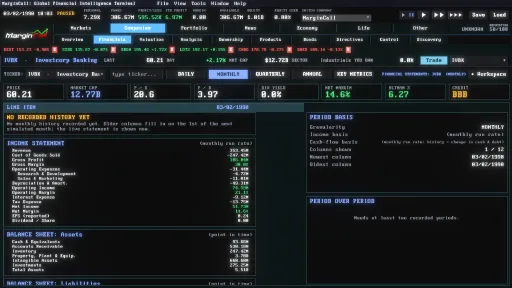
- Margins now come out realistic across all companies (roughly 45% gross, 20% operating, 14% net on a typical name).
- The monthly view is now labeled MONTHLY (est.) with a note explaining it is the quarterly figure divided by three.
Positions & Holdings
- Positions page now shows Realised P/L.
- Dividends are included in Realised P/L and also listed as their own category.
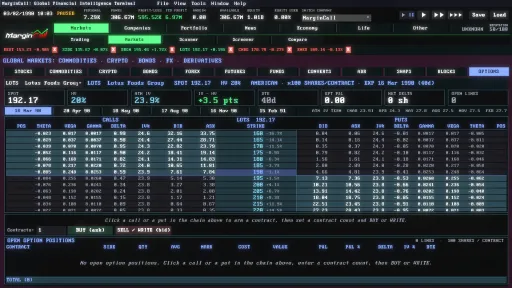
- Options and Futures now appear on the Positions page.
- Holdings in the Markets tab now show the date acquired and income earned per holding.
Trading & Markets
- Fixed the Buy and Sell buttons showing no price on the trade ticket.
- Fixed the detail note overlapping the position panel on the Markets tab.
- Added per row Close buttons to the open positions strip (no more flashing).
Other UI
- Fixed the buildings screen so it scrolls properly.
- Cleaned up the messy spread numbers on Compare then Countries.
- Made the "(off)" mandate text bright and bold so it reads clearly.
- Renamed the sidebar News tab to NEW so it fits.
- Added a character assets summary row to the Life page.
- Added treemap type and sector click filters.
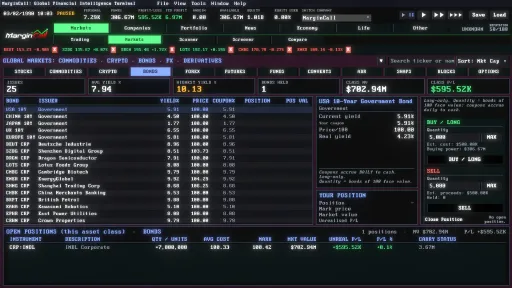
- Added issuance capacity feedback to the Bonds page.
- Set CRT off by default, Glow off by default
Stability
- Forced a reverse stock split when a share falls below $1 so companies no longer drift toward a zero price.
- Verified money conservation on subsidiary liquidation, fund respawn, nesting, and reverse splits.
This update lets you recolour the entire terminal with a set of built in colour themes, and fixes how the game behaves when you switch theme, along with a batch of pause, loading and settings issues.
Existing saves are compatible.
Added
Colour themes for the whole terminal, chosen from a new Theme setting under Settings, Graphics. Seven full palettes are included: Terminal Green (the classic look), Amber Terminal, Midnight Bloomberg, Arctic Ice, Solarized Dusk, Synthwave, and Paper, a light daytime theme.
A theme picker shown as preview squares. Each square is split on the diagonal, the theme's panel colour on top and its accent colour underneath, so you can read the look of a theme at a glance before choosing it.
Every part of the interface now follows the selected theme, including the trade controls, the buy and sell tickets, news category tags, the economy indicators, the research reputation ladder and the chart overlays, not just the window chrome.
Changed
Selecting a theme now pauses the game and keeps it paused while it reapplies, so the simulation holds still and you resume with Play when you are ready.
The screen now loads fully populated the moment you enter or reload a game, even while paused. The date and time, header figures, ticker strip, order book, live prices and last trade all appear straight away instead of reading zero until time had passed.
Amber Terminal now uses a neutral dark background with amber kept for the text and accents, instead of an orange tint across the whole screen.
Solarized Dusk text is brighter and stands out more, and Arctic Ice text reads more crisply.
Text now switches to a readable colour whenever it would otherwise sit too close to its background, so nothing turns invisible on a light theme.
The brand logo stays readable on light themes. The white part of the wordmark is recoloured so it no longer disappears against a pale background.
Settings menu information text now fills the width of the panel instead of wrapping early with empty space beside it.
Fixed
Fixed the game unpausing itself when you opened the pause menu on an already paused game and then returned to the game. A paused game now stays paused, and a running game resumes at the speed it was on.
Fixed the same unwanted unpausing on the Report Bug popup.
Fixed light themes washing out to solid white. The CRT glow now scales to each theme, so a bright theme like Paper no longer blooms the whole screen out.
Fixed the loading screen leaving a black chart panel on light themes.
Fixed changing theme pushing the clock forward. Applying a theme rebuilds the world in the background, which could advance the date by roughly a week each time. A theme change now holds the date and time exactly where you left them.
This update improves company financial statements, surfaces the data the simulation was hiding from you, lets you own and run many companies at once, adds proper downturns, and fixes a batch of market, accounting and performance bugs.
Existing saves are compatible.
Added
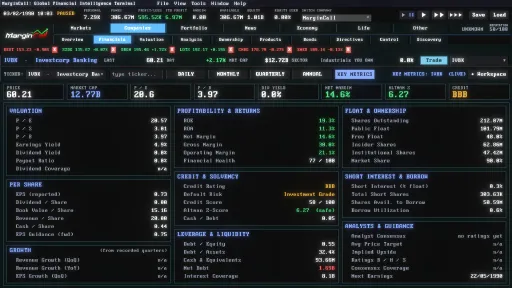
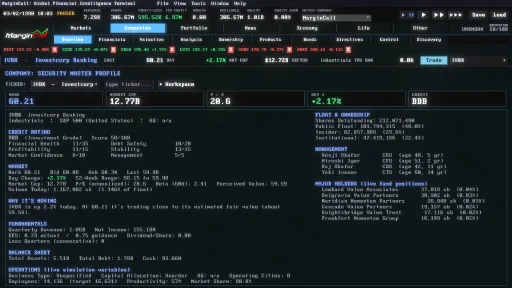
Full financial reports for every listed company: income statement, balance sheet, cash flow and key ratios, all reconciling to the same ledger.
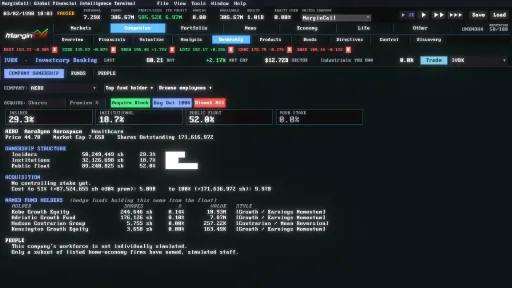
A company information panel that surfaces data the game already tracked but never showed you: credit rating with its score breakdown, float and ownership (shares outstanding, public float, insider and institutional stakes, and the actual hedge funds holding the stock), volume, EPS actual versus guidance, dividend per share, headcount, productivity and market share.
Consolidated group financials that roll a parent and its subsidiaries into one set of statements.
Own and run many companies at once. A new SWITCH COMPANY header control lists your own company first (shown as current even before it lists), then your private subsidiaries, then every company you control, sorted alphabetically.
Private, founded subsidiaries now sit alongside your listed holdings in the switcher.
Autonomy levels for companies you control, from full hands-on management to fully delegating them to the AI.
Activist campaigns to pressure companies you own a minority stake in.
Hedge fund fees: funds now charge a "2 and 20" style management and performance fee against a high-water mark.
An HHI reading on the Economy screen showing how concentrated each sector is.
Central bank policy regimes (on-hold, tightening, easing, emergency).
Plain-English explanations for why a price is moving and how a valuation is built.
Changed
Company earnings now grow from real business drivers (market share, consumer demand, productivity and the company's own economy) instead of a random walk, so earnings can be forecast and an earnings surprise actually means something.
Real economic downturns and recessions can now occur, instead of the economy only ever growing. Adverse shocks are spaced out so slumps emerge naturally without chaining into catastrophe.
The main menu music now always opens with the title track.
Games start with 100 companies, so The Billionaire 100 is full from day one.
Crowded trade readouts show the top 3 names instead of running off the screen.
Widened the Financials ticker box, and the chart settings buttons now fit their labels.
Selected rows use a softer green highlight instead of the strong blue.
Settings menu text now fits, and the Discovery screen's green shades are explained in place.
The "+ Workspace" button is now just "+" so it no longer collides with the chart toolbar.
Removed the "Simulation paused while the menu is open" line from the main menu.
Fixed
Fixed muting in Settings tanking the framerate. Mute made the menu music look like it had stopped, so the game tried to start the next track every frame. It now leaves the music alone while muted and resumes on unmute.
Fixed cryptocurrencies only ever falling after launch, so a coin can now actually climb.
Fixed every company being valued off the United States economy. Company valuations now correctly use their own country's rates, inflation and growth.
Fixed spin-offs conjuring a balance sheet from nothing. The new company's cash and retained earnings are now carved out of the parent by its share of revenue.
Fixed dividends creating money. Payouts are now funded from the company's own cash and retained earnings.
Fixed the constant "climbed the ranks" notification spam. Alerts are now throttled and only fire on a real change.
Fixed the financial statements vanishing when you scrolled the reporting screen.
Fixed the hover sound behaving like a static pop that got louder as you swept the cursor. It is now a clean, audible mechanical click.
Fixed the SWITCH COMPANY cell not showing your own company before it had been listed.
Fixed the Macro by country table falling out of line on the United Kingdom row.
Removed
Removed the old hover sound asset in favour of a procedural click.
Market and economy stability Update
This is a large one. The market and the underlying economy have both been rebuilt to move realistically: a gentle long-term uptrend with normal volatility and occasional real drawdowns, instead of violent global crashes and rallies that had no worthy cause behind them. Along the way we found and fixed a set of unit and calibration bugs deep in the economy simulation that were breaking things silently within the first few game weeks of every save.
Existing saves are compatible and are repaired on load.
Added
Company earnings are now staggered across the reporting quarter. Every listed company used to report on the exact same tick, four times a year, which made the entire market lurch at once. Companies now report on their own schedules, so earnings season is a rolling stream of news rather than a single market-wide event.
Market indices now maintain a proper divisor. An IPO, a delisting, a merger, a buyback or a share issue no longer moves the index by itself. The index only moves when prices move, the way a real index works.
Index members are now marked on a genuine two-sided quote, falling back to the last real trade. Previously the index could move several percent on a book that was momentarily one-sided, with no trade behind it at all.
Resource reserves now grow slowly over time through discovery and recycling, scaled by your economy's resource technology, so an economy is no longer on a fixed, one-way path to exhaustion.
Forced liquidations, whether from margin calls, fund shutdowns, tycoon exits or algorithmic cascades, now work in depth-limited slices instead of dumping an entire position into the book at once. A large forced seller still moves the price, it just can't vaporise the order book in a single tick.
A soft dislocation signal now tracks how far a stock has moved from its daily reference price. Trading halts remain off by design; this is groundwork for damping cascades without silently blocking your orders.
Saves are now marked when the cheat console has been enabled during that run, and the load menu shows a CHEATS tag on any affected slot. The marker is sticky for the life of that save, so a cheated run can always be told apart from a clean one. Starting a new game clears it; the Settings toggle itself is a preference and is left alone.
Changed
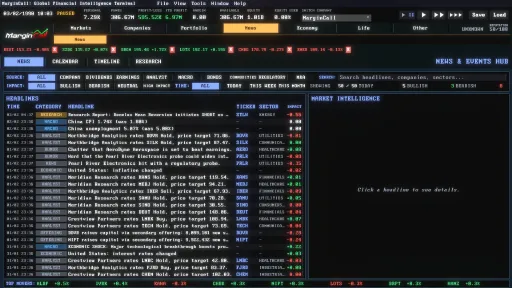
News sentiment now uses one consistent scale across the whole game. Routine items such as an analyst note or an unconfirmed whisper sit at the bottom, notable events such as a rate surprise, an earnings beat or a fund failing in the middle, serious ones such as a sector shock or a major bankruptcy above that, and only genuinely systemic events like a sovereign default or a market-wide crash reach the top. Previously a takeover rumour about one company shouted louder than a central bank decision.
Rumour magnitudes have been halved. A rumour about a single company is significant, but it should not read to the market like a global crisis.
Value and contrarian investors now step in much earlier, at an 8 to 15 percent dislocation rather than waiting for 16 to 30 percent, while trend followers need a stronger move before they pile in. The two groups now overlap, so a move meets opposing flow while it is still small instead of running unopposed until it is violent.
Liquidity now thins under stress but never empties out. The ceiling on how far market makers withdraw has been lowered, so a shock still widens spreads without tipping into a self-sustaining vacuum.
Retail panic and FOMO participation now ramps up smoothly with market stress instead of snapping on at a threshold that a routine intraday move could cross.
Company valuations now ease toward new fundamentals over about a game day rather than jumping the instant an input changes. Earnings releases, rate decisions and sector shifts now arrive as a ramp, not a gap.
Acquirers now issue shares to pay for a takeover. Previously an acquirer absorbed the target's entire earnings stream for free, which permanently re-rated it upward for no economic reason.
Central banks now move in increments, capped at 0.5 percentage points per meeting.
Analyst ratings now trickle out daily instead of arriving as one large batch every ten days.
Buybacks, spinoffs and tycoon trades are now spread across their cycles rather than all firing on the same tick.
Fixed
Market behaviour
Fixed the market gapping violently every 90 days. A bounded "how does the economy favour this sector right now" figure was being compounded into each company's revenue base every quarter instead of applied as a one-off level. With the shipped numbers that halved Energy and Materials earnings every single quarter and inflated Consumer Discretionary earnings by 22 percent every quarter, forever, for every company in those sectors in every country, all on the same tick.
Fixed a commodity price calibration error that made the above far worse: crude was being compared against a reference price four times higher than the price it actually lists at, so every sector permanently carried a large false penalty or bonus.
Fixed company revenue growth ratcheting up to its sector maximum and staying there. Technology companies were compounding revenue at roughly 75 percent a year indefinitely, which detached prices from anything a player could reason about. Growth now settles at a sensible rate and drifts.
Fixed the per-company market maker walking its own book. A macro tilt intended as a small nudge was displacing its whole quote ladder by up to 2 percent off the last trade, several hundred times a game day, on every company in a country at once, and because its quotes are live, that displacement executed against real orders and became the next anchor. It was a self-feeding exponential in price with no fundamental brake.
Fixed momentum traders having a hair-trigger exit. Entering a trend required a 3 percent move but exiting fired the instant price crossed its own short-term average, so every trend follower in the game unwound inside the same handful of ticks and the move fed on itself. Exits now require a real reversal.
Fixed order flow arriving in synchronised market-wide bursts. Trading desks all decided on identical ticks and each cancels its resting orders before requoting, so liquidity was withdrawn everywhere at once and reposted everywhere at once. Every desk now has its own schedule.
Fixed all hedge funds reviewing their positions on the same daily tick against the same shared valuation, which turned any market-wide valuation move into one synchronised industry-wide order burst.
Fixed every ETF and index fund executing its monthly flows into the same handful of large companies on a single tick.
Fixed margin calls being able to cascade. A forced sale swept the whole book, which lowered account equity again and could trip every other holding on the very next tick. Liquidations are now sliced and rate-limited.
Fixed algorithmic flash crashes being sized from a company's share count rather than from the liquidity actually available, so every burst swept the entire order book regardless of what was resting there.
Fixed fund shutdowns deleting shares. When a liquidating fund's sell order couldn't be filled, the unsold shares vanished from the simulation instead of remaining on its books.
Fixed tycoons being able to dump an entire accumulated stake in one unclipped order while their buying was capped, and fixed all of them trading on the same weekly tick.
Fixed poison pills creating money. Issuing defensive shares was crediting the company with cash equal to 12.75 percent of its market value out of nothing, alongside the intended dilution.
Fixed spinoffs inflating the market. A parent company's earnings were reduced when it spun off a division, but its per-share earnings weren't recalculated until its next report, up to 90 days later, so the new listing's value was counted immediately while the parent's reduction arrived weeks after.
Fixed a company's valuation jumping upward when it started losing money. A hard floor in the valuation model meant a company whose earnings drifted from barely positive to slightly negative suddenly appeared to be worth around thirteen times more. Loss-makers are now valued against their book value, and the transition across zero is smooth.
Fixed a company's valuation dropping over 50 percent in a single release on its third consecutive loss-making quarter. The risk penalty was a cliff; it is now a ramp.
Fixed the market index jumping when a company listed, delisted or changed its share count, with no price movement behind it.
Fixed circuit breakers being an empty stub that did nothing at all.
Saved games
Fixed a serious save-corruption bug: loading a saved game permanently zeroed every company's revenue and earnings. Because the field the save file stores was being cleared at the end of every earnings release, a loaded game restored a revenue base of zero and could never recover. The entire market collapsed onto a fallback valuation of roughly 18 dollars a share for every company, regardless of size. Loading an affected save now rebuilds each company's revenue from its stored earnings.
This also un-broke several readouts that were quietly reading zero as a result, including sector revenue and profit margins and company staffing targets.
The economy
Fixed the economy silently breaking within about a game week and a half. A feedback loop in agricultural investment was multiplying capital by roughly 744 times a day, because it was comparing national food supply against a small population sample, which drove the figure past the limits of the number type on day 11 and poisoned pollution, public health, mortality, the labour market and service output with invalid values from then on. Nothing in the economy layer was guarding against this.
Fixed GDP growth being pinned at its maximum from day one of every game. A consumer spending term was reading a national total against a scale calibrated for a per-person figure, contributing thousands of times more than every other input combined. The growth rate now settles near trend, with each day's change bounded so no single subsystem can rail the whole economy.
Fixed industrial, service, agricultural and resource capital compounding at 6 to 8 percent per day. Their investment rates were written as annual figures but applied daily, while depreciation on the very next line was correctly divided by 365.
Fixed everyone in the population ageing a full year every game day. The workforce aged out entirely within about seven game weeks, at which point unemployment and participation locked at zero permanently, consumer spending fell to zero, and no new workers could ever enter. People now age once a game year.
Fixed pollution reaching its maximum possible level on game day two and never coming down, which dropped life expectancy by 15 percent in a single daily step and permanently suppressed births, environmental quality and growth. Consumer pollution was being calculated from a national spending total against a per-person intensity.
Fixed resource depletion being a one-way ratchet that cut industrial output by 70 percent within about four game months of every game, permanently, with no way to recover.
Fixed the sovereign default headline firing every few game days. National debt was seeded in different units from GDP, which put the opening debt-to-GDP ratio at 30 rather than the intended 0.6, so a default fired on each of the first five days of every new game, each one at maximum negative news impact.
Fixed bank deposits and loans compounding at over 1 percent per day. An interest rate expressed as a percentage was being used as if it were a decimal fraction.
Fixed city house prices moving 8 percent up or 90 percent down in a single day. The price adjustment was neutral only at exactly 5 percent vacancy, which essentially never occurs.
Fixed three separate systems all writing the central bank's interest rate every day and pulling against each other. The policy rate now has one owner, the central bank, with government policy applying a bounded offset around it.
Fixed the Taylor rule being double-counted, which made the effective inflation response nearly twice the intended strength, moved rates by up to 0.9 percentage points in a single meeting, and left rates settling well away from the bank's own target.
Fixed government monetary policy pushing rates the wrong way. A tightening stance was lowering rates and a loosening stance was raising them.
Fixed the currency market running at roughly 42 percent annualised volatility at all times. A crisis volatility bonus was permanently half-applied because it scaled linearly from a level that normal conditions sit at.
Fixed a currency drift bug that produced a deterministic multi-year bear market and recovery with no event behind it. Fundamental exchange-rate pressure was being applied twice, and that fed through imported inflation into every company's valuation.
Fixed bond yields double-counting their inflation and term premiums, so every quoted yield was too high by a wide margin.
Fixed inflation being able to jump by around 10 percentage points in a single day. Wage growth was measured day-over-day across whoever happened to be employed that day, against a hardcoded starting figure, and then multiplied by fifty.
Fixed inflation sawtoothing on a 7-day cycle during any economic shock, which printed contradictory "inflation changed" headlines twice a week.
Fixed the national debt ratio moving in the wrong direction. Running a deficit was reducing it.
Fixed non-home countries compounding their GDP roughly four times too fast, and the home country compounding it through two paths at once.
Fixed roughly half of all economic shocks publishing a headline and then having no effect on anything at all.
Fixed beneficial economic shocks making things worse during a downturn. The shock multiplier was applied to a value that can be negative, which inverted its meaning.
Fixed a set of unit errors that left welfare, nutrition, food access, fertility and crop yield permanently stuck at the edges of their ranges and therefore completely unresponsive to the economy. Income per person was off by several thousand times, food supply was compared against calorie thresholds while being measured in tonnes, and the crop yield limit was set above the value it was clamping.
News and information
Fixed most news carrying no market signal at all. Sovereign defaults, flash crashes, company bankruptcies, exchange hacks, regulatory bans, economic shocks, analyst ratings and insider chatter were all published as "no information", so trading agents ignored them entirely, while a single takeover rumour moved everyone. All of these now carry a weighting appropriate to how serious they are.
Fixed one hedge fund closing being the single loudest event in the game, louder than a sovereign default and around 27 times louder than a realistic inflation or rate release.
Fixed the news feed being flushed by chatty publishers. A batch of around 75 analyst notes every ten days wiped every prior headline out of the market's attention window in one tick and reset perceived sentiment to exactly zero, which is why sentiment could swing out of nowhere. Sentiment now has its own, much deeper history separate from the visible feed.
Fixed uninformative headlines diluting real signals. Filler news no longer counts toward the market's sentiment average, and no single headline can dominate it.
Fixed macro releases being roughly two orders of magnitude too quiet. A realistic rate change or inflation print now registers as meaningful news.
Fixed crypto and company-specific news reaching every company in the world at full weight instead of being scoped to the sector it concerns.
Removed
Removed the compounding sector earnings multiplier that was applied as a growth rate rather than a level. It was the single largest cause of the quarterly market gaps.
Removed the third daily writer of the central bank interest rate, which drifted the rate by up to 1.8 percentage points a year with nothing correcting it and no visibility to the bank's own policy rule.
Removed the weekly inflation reset that was fighting the two daily systems writing the same value.
Removed a large block of unreachable trading logic. An entire per-country macro pathway covering reaction delays, regional economic signals and news misinterpretation was computed for every trading desk on every decision and then discarded because of a condition that could never be true. It is now wired into their quoting.
Removed the non-deterministic random source from the rumour system, which broke replay consistency.
Added
Cornering a company now genuinely changes its market. As you buy up a name's tradable shares, the order book shows a live "Available" float that shrinks, its stock becomes hard to borrow, resting offers thin out, and a short squeeze in your favour becomes far more likely. Previously you could buy the entire public float and the market would still behave as if there were bottomless shares to trade.
The order book footer now shows how much of the float is still actually tradable ("Avail" with a percentage), and flags a name as Hard to Borrow once it is nearly cornered.
The 25% / 50% / 75% quick-size buttons now sit on their own row beneath the quantity box in the order ticket, so the quantity field has room to show the full number of shares you are about to trade.
Fixed
Fixed the trade tape printing endless deep buy and sell volume from other participants even after you had bought up a company's entire public float. AI desks can now only sell shares they actually hold and only short shares they can actually locate to borrow, so liquidity realistically dries up as you corner a name instead of showing fake, bottomless supply.
Fixed "Held by others" in the order book being back-calculated from your own position (so it always reconciled perfectly and hid what was really happening). It now reflects the real insider, institutional and market-participant ownership, tracked from actual share flows.
Fixed the per-company market maker being able to conjure sell-side offers out of nothing. Its ability to go short is now bounded by real borrow availability and collapses to nothing once a float has been cornered, so the offer side of the book empties out the way a genuinely hard-to-borrow stock would.
Fixed short squeezes being masked by that fake liquidity. Cornering a float now properly feeds the squeeze system, so trapped shorts get run over when supply is scarce instead of the setup being invisible.
Fixed the quantity field in the order ticket clipping large share counts (showing something like "284,3..." instead of the full amount). The size-preset buttons were moved to their own row to give the field full width.
Fixed the Order Book and Trades tabs not updating when you clicked them while the game was paused. They now refresh immediately on click instead of waiting for time to move.
Fixed missing thousands separators on the "last move" share count at the top of the trading screen and on the Positions unrealised P&L and long/short share figures at the bottom, so large numbers are now readable at a glance.
Fixed numbers being clipped in the Order Book and Trades panels. Both now use the full width of the panel and render at a consistent size, so large prints like a million-plus share trade show in full.
Fixed the watchlist ticker bar text being too small for the space available. It now uses the standard text size, with a subtle alternating highlight on each ticker and its close box so it is clear which X belongs to which ticker.
Removed
Removed the cash-funded short selling that let AI desks keep supplying sell-side volume regardless of how many real shares were actually available to borrow.
Removed the "shares held by others" placeholder that was derived from your own holdings rather than from real ownership.
Current Release
Build 25568502
Uploaded Oct 10, 2026
System Requirements
How to Install
MarginCall.exe to play
Troubleshooting tips
• Run Redist/_CommonRedist installers if game won't start
• Add folder to Windows Defender exclusions
• Run as administrator
Download
Direct link available
Needed when extracting (WinRAR / 7-Zip) — not a site login.
3C5931A7
41d88f8de8441fa199df31d419ec8e25509f612d4ad0edf4cbfee6a683e57a33
You May Also Like
View All










Download MarginCall for PC with a direct link or via torrent. Get the full version of MarginCall for free. MarginCall is a Indie released by Functionally Human.